Get Full Government Meeting Transcripts, Videos, & Alerts Forever!
Get email alerts on the Enrollment Budget topic
No spam. Unsubscribe anytime.
Marblehead subcommittees confront 8% enrollment drop as they build FY27 school budget
Summary
Residents and committee members told a joint Marblehead subcommittee a drop from 2,727 to 2,511 students — a loss of 216 pupils, about 8% — is driving scrutiny of staffing lines and special-education costs as administrators prepare the FY27 budget.
Sarah Fox, a Marblehead resident, opened public comment by flagging a sudden enrollment decline that she said is already reshaping the district’s finances. “On June enrollment … our enrollment was 2,727. Today's enrollment was 2,511. In less than 6 months, that's a 216 student decline, which … is 8 percent,” Fox said, and asked how the drop will affect staffing and future funding requests.
The topic formed the core of a detailed budget presentation and discussion by school staff and members of the school committee’s budget subcommittee and the finance committee liaison subcommittee. Mike, a school staff member who presented a departmental budget spreadsheet, walked members through the district’s ‘buckets’ — schools, athletics, student services, teaching and learning, finance and HR, technology and facilities — and explained how teachers, instructional assistants, summer salaries and special-education salaries are recorded.
Committee members pressed for clearer role descriptions for instructional coaches and lead teachers and for transparent links between enrollment figures and salary lines. Staff said the district currently budgets four instructional coaches (about $405,000) who work across grade levels on curriculum, coaching and embedded professional development; members asked for a written roles-and-responsibilities summary to justify the headcount and explain how those positions differ from historic curriculum-director roles.
Special education repeatedly came up as a cost driver. Members discussed that, after removing transportation, roughly one-quarter of salary dollars may be tied to special-education services in this draft analysis; staff emphasized that tuition, contracted services and out-of-district placements also inflate costs and that building in-district programs to reduce tuition payments will take several years.
Members asked staff to verify recent enrollment data and the timing of move-ins and move-outs in Aspen, the student information system, after one participant said the district’s weekly report showed a drop of 25 students in a single week. Staff agreed to audit the counts and return with reconciled numbers and clearer per-school impacts.
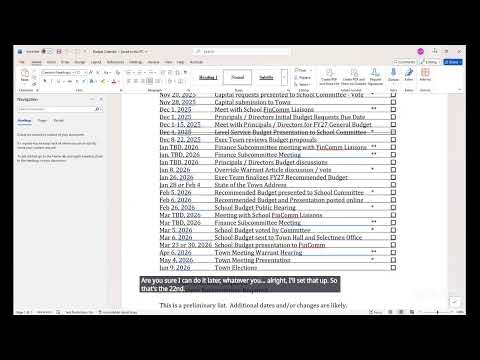
Next steps set in the meeting included district follow-up with principals, a request to quantify special-education spending as a percent of wages, and a schedule to present a recommended budget to the full school committee for public hearing in late February, with subsequent FinCom and warrant-hearing steps.