
Policy committee hears Chapter 104 presentation; staff proposes study of universal screening
Get AI-powered insights, summaries, and transcripts
Subscribe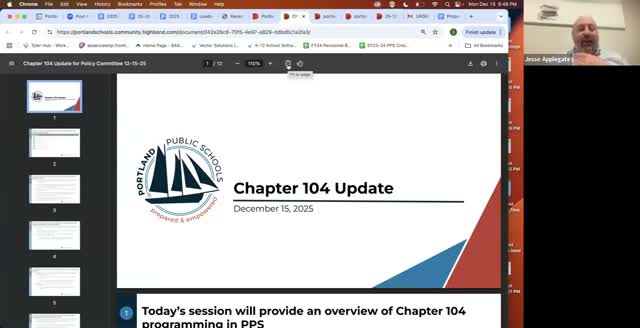
Summary
Staff outlined Chapter 104 (gifted) programming, explained the consultation delivery model, reported current identification and staffing counts, and proposed studying a shift to universal screening (pilot at East End Community School) to improve proportional representation of identified students.
Portland Public Schools staff presented an overview of the district’s Chapter 104 programming for gifted and talented students and asked the policy committee to consider a study of universal screening to improve equity in identification.
Jesse Applegate, senior director for special education and student support, and Kathy Ball, the district Chapter 104 coordinator, told the committee the district currently staffs five full‑time Chapter 104 consultants (three elementary, two middle school) and serves roughly 150 elementary and 229 middle school students through consultation and occasional pullouts. Ball said the district’s identified population historically falls well short of the state’s expected proportion, noting the state expects a much larger share than the district’s usual 5% identification rate.
Ball described the identification process as a two‑step approach: (1) districtwide data screening (formal screening in grades 3 and 5, with fall and spring testing windows) and (2) team review of objective and subjective measures that determine who proceeds to CogAT testing. In 2024 the district screened 235 students (grades 3 and 5) and identified 116.
Staff recommended two policy changes: an explicit statement that "Portland Public Schools will maintain a program for gifted and talented students in compliance with all applicable laws and regulations" and a commitment to study shifting to universal screening to ensure proportional representation. Applegate and Ball said the district is piloting universal screening at East End Community School and will report feasibility findings to the board if the committee supports study and planning.
Committee members raised operational questions: why the district screens in grades 3 and 5, how identified students transition to high school, how multilingual learners are screened, and the staffing and fiscal implications of expanding screening. Staff said the state does not prescribe screening ages, the district shares identified student data with high school counselors for placement, and a separate process for multilingual learners has helped identify students who may have been overlooked.
Next steps: staff will work with legal counsel and the curriculum committee on redlines, and the curriculum committee indicated interest in further study and an ongoing review of Chapter 104 programming.