Get Full Government Meeting Transcripts, Videos, & Alerts Forever!
Get email alerts on the Water Supply Esmeralda topic
No spam. Unsubscribe anytime.
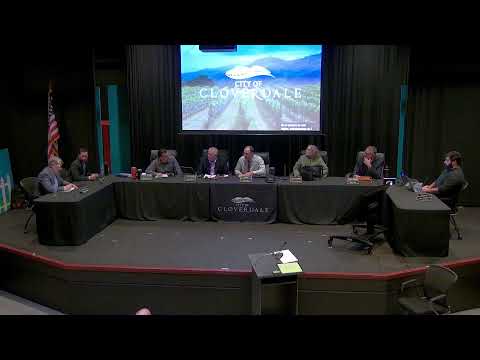
Cloverdale council adopts water‑supply finding for Esmeralda project after debate, 4–1
Summary
After a technical presentation and three hours of public comment, the Cloverdale City Council voted 4–1 to adopt a November 2025 water supply assessment and verification for the proposed Esmeralda mixed‑use development, finding supplies sufficient under a range of scenarios while several residents pressed for independent review and raised contamination concerns.
The Cloverdale City Council voted 4–1 on November 30 to adopt a water supply assessment (WSA) and water supply verification (WSV) for the proposed Esmeralda mixed‑use development, clearing a procedural hurdle that will be part of future environmental review but does not itself approve the development.
Consultant Brad Arnold of EKI summarized the technical report and told the council the WSA/WSV “indicates that Cloverdale has sufficient and reliable water supplies to meet the projected demands, including that with the project through 2045” under a range of hydrologic conditions. The study accounts for droughts and the possible decommissioning of the Potter Valley Project and relies on Cloverdale’s senior water rights and the city’s 2021 Urban Water Management Plan for baseline inputs.
The WSA estimated the project’s total potable water demand at about 76,000,000 gallons per year at buildout and said that could be reduced to roughly 49,000,000 gallons per year if non‑potable sources are used for landscape irrigation. The consultant and developer also pointed to planned infrastructure contributions: two 500,000‑gallon storage tanks sited on the project hill would be dedicated to Cloverdale, and the developer stated the project would pay impact fees to support water, sewer and other systems.
Opponents and some residents expressed skepticism. Water system operators, residents and activists repeatedly asked for an independent third‑party review and questioned assumptions about Potter Valley decommissioning, underflow behavior, and long‑term drought frequency. Jennifer Sullivan, citing historical site data, raised concerns about polychlorinated phenol (PCP) contamination on portions of the former mill property and read deed restrictions that limit excavation and certain uses in a small subarea. The developer responded the deed‑restricted subarea is excluded from the proposed residential footprint and asserted the North Coast Regional Water Quality Control Board has recommended closure of the site’s open cases if covenants are observed.
Several speakers also asked whether the consultant’s work was independent because the work was funded by the applicant. City staff and the applicant said the draft was reviewed by the city’s consultant (West Yost) and by an independent reviewer (Eddie Teasdale) and by legal counsel with water rights expertise. Brad Arnold said the WSA went “above and beyond” the standard state checklist by modeling worst‑case Potter Valley scenarios and accounting appendices that trace contributions from Lake Mendocino and other sources.
Council members voiced differing priorities during deliberations. Supporters said the technical work and city peer review were sufficient for tonight’s narrow decision; opponents wanted additional independent review or more public engagement. Councilmember Marquez moved to adopt the findings; the roll call was Lasky Aye, Morgenstern No, Marquez Aye, Vice Mayor Wheeler Aye, Mayor Lance Aye. The motion passed 4–1.
City staff and the developer emphasized this vote adopts only the technical water findings required by state law and is not an approval of the development entitlements. Future votes, including the project’s tentative map, development agreement and CEQA certification, remain to be scheduled. Several council members and public speakers urged the city to organize additional town halls and to compile an index of prior technical reviews if residents want a further independent assessment.
The council adjourned discussion of the Esmeralda project’s other entitlements to future hearings.