Get Full Government Meeting Transcripts, Videos, & Alerts Forever!
Get email alerts on the K 12 Education topic
No spam. Unsubscribe anytime.
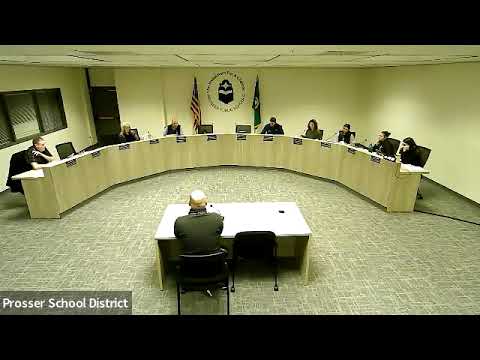
Prosser High narrows school-improvement goals as proficiency gaps persist
Summary
Prosser High School leaders told the district board they are narrowing their improvement plan to two priorities'freshman success and strengthened PLC data practices'after reporting 71% ELA proficiency but roughly 39% in math and an expected drop in the four-year graduation cohort now that COVID waivers have ended.
Prosser High School presented a pared-down school improvement plan focused on freshman success and building-level professional learning communities after trustees raised concerns about how state-reported proficiency levels relate to graduation rates.
Mister Baylor, who presented the high school's summary, said the school maintained a 90% graduation-rate goal but expects last year's four-year cohort to fall to about 85% because the COVID-era waivers that previously helped some students are no longer in effect. "Our graduation rate goal is still 90 percent," Baylor said. He also reported the school is "about 71% proficient in ELA, based on our most recent scores and 39% proficient in math," calling the math result "not great."
Why the numbers diverge: Baylor told the board that multiple graduation pathways and test-choice behavior can produce high graduation rates alongside low SBAC proficiency. He noted the state now recognizes seven pathways to graduation and said students who opt into alternative routes (career-technical endorsements, ASVAB, college-acceptance routes) may not take the SBAC, explaining in part why the school's graduation figure and SBAC proficiency appear inconsistent.
The principal also described a shift in focus inside the building. After working with coaches from the Educational Service District and the middle school, staff moved to a Gantt-charted set of weekly tasks tied to two measurable goals. Baylor said teachers will form PLCs that target specific, recurring failure-patterns in their classrooms and design trimester-length SMART goals to test interventions. "We're gonna revamp our professional learning communities away from content area teams to specific actionable items," he said. The PLCs will be supported by new data pulls from Skyward and school-level spreadsheets so teachers can track student progress at micro and macro levels.
Board members pressed for more community-facing reporting. A trustee urged the district to publish local metrics such as rates of A/B grades or the number of students enrolled in higher-level math as complementary diagnostics to the state report card. Baylor agreed and said he would supply additional internal data on request.
The district also agreed to continue monitoring freshman-success programming led by David Funk and to reconvene on progress after the end of the trimester. The board did not take formal action on the improvement plan at the meeting; the presentation was accepted for discussion and follow-up.