Get Full Government Meeting Transcripts, Videos, & Alerts Forever!
Get email alerts on the Zoning Setbacks topic
No spam. Unsubscribe anytime.
Milton council weighs changing AG‑1 setbacks to preserve trees and backyard space
Summary
Councilors spent more than an hour debating RZ2508, a text amendment that would let certain new AG‑1 subdivisions swap front and rear setbacks (options range from modest flips to larger changes) to preserve tree lines and manage septic/stormwater issues; staff will return with more visuals and comparative data in January.
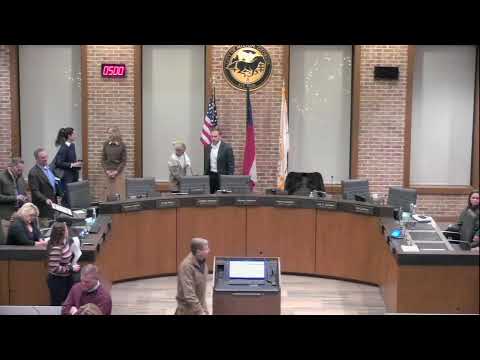
Mayor Payton Jamieson and the Milton City Council spent extensive time on Dec. 1 discussing RZ2508, a proposed amendment to the Unified Development Code that would allow qualified subdivisions in AG‑1 zoning to alter standard front and rear building setbacks.
Interim community development director Diana Wheeler told the council staff had developed three principal options: keep the existing 60‑foot front/50‑foot rear standard; Option A (flip to 50‑foot front/60‑foot rear with a 15‑foot tree‑preservation strip); and Option B (40‑foot front/70‑foot rear with a 30‑foot preservation area). The planning commission recommended a compromise — a 45‑foot front/65‑foot rear standard with a 20‑foot preservation zone and a 25‑foot pool setback — after hearing neighborhood testimony in November.
"We looked at building flexibility in terms of the setbacks in order to preserve trees," Wheeler said, adding the proposal would not increase lot density and would apply to qualified subdivisions (generally lots under three acres with no pass‑through access).
Public commenters and council members offered contrasting views. Tom Gallagher, a Taylor Glen resident, told the council that his pie‑shaped lot and rear‑facing property would be negatively affected by nearby development and that protections agreed with the developer (including a 70‑foot rear setback and a 30‑foot tree protection zone in one option) were important in his case.
"Our property and values would be negatively impacted by the development directly behind our home," Gallagher said, urging the council to consider the planning commission's recommendations and the site‑specific protections put on the table.
By contrast, Mark Sanfitello said there was "no data" indicating a citywide need to change the longstanding 60‑foot front setback and argued the city should avoid making broad code changes when variances, waivers and individual reviews can address isolated problems.
Council discussion focused on tradeoffs: whether a citywide change would undermine the agricultural/equestrian character of Milton, whether smaller front yards would create an inconsistent streetscape, and whether administrative or planning‑commission review would be the right process. Several council members supported more flexibility if the change preserved mature trees in rear yards. Others preferred retaining the current standard and handling exceptions through the variance process.
Council members asked staff for additional visual examples, comparisons with neighboring jurisdictions, and guidance about how phased developments (for example, a phase 2 that abuts an existing phase 1) would be treated. Wheeler said staff would return with more examples and data at the first meeting in January.
The council did not vote on RZ2508; no formal action was taken. Wheeler said the item will come back in January for further consideration after additional analysis and visuals requested by the council.
What happens next: staff will produce more visual comparisons and jurisdictional data and return the item for possible first‑reading action at the Jan. 5 meeting.