Get Full Government Meeting Transcripts, Videos, & Alerts Forever!
Get email alerts on the County Budget Levy topic
No spam. Unsubscribe anytime.
Pine County previews $60M 2026 budget, proposes 2.6% levy increase as residents report steep valuation-driven tax hikes
Summary
County staff outlined a proposed $60 million 2026 budget and a 2.6% preliminary levy increase; officials said higher highway project spending and valuation changes — including new construction — explain much of the rise, while residents reported individual tax jumps of about 30% and asked about tax-forfeiture timelines.
Pine County officials presented a proposed $60 million budget for 2026 and a preliminary 2.6% property tax levy increase at a Truth in Taxation hearing, and answered questions from residents who reported large, valuation-driven tax increases.
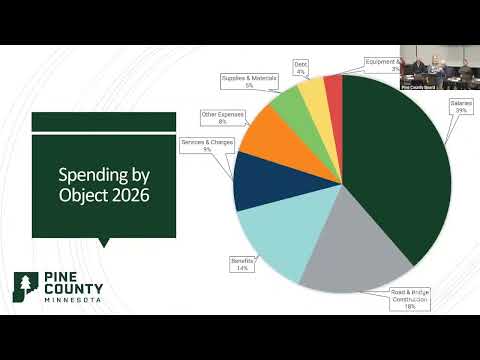
Kelly, a county staff presenter, said the county’s budget process began in July with department requests and multiple review meetings; the board adopted the preliminary levy Sept. 16 and will consider the final budget and levy at a Dec. 16 meeting. Kelly noted total county expenditures are projected to rise from about $53 million in 2025 to about $60 million in 2026, driven chiefly by roughly $6.3 million in project-based highway spending tied to a five-year road plan.
The presentation described the county’s fund structure: general government, health and human services, highway, building funds, three debt funds (including a jail bond and a 2017 capital improvement program bond for the Northpointe Government Center), a technology equipment fund and a new annual elections fund set at $25,000. Kelly said the general fund faces about a $517,000 shortfall for 2026 but that planned use of roughly $350,000 in reserves would reduce the net deficit to about $160,000.
Explaining how property taxes are calculated, Kelly walked through tax-capacity math: taxable market value multiplied by state class rates yields tax capacity, and the county levy divided by county tax capacity produces the county tax rate. Kelly gave an example saying the proposed county tax-rate share would produce roughly $1,073 in county property taxes on a $250,000 home under the 2026 proposal.
Several residents challenged their own assessments. Karen Soderquist of Cross Lake told the board her taxes increased by 30.05% from 2025 to 2026. Kelly and other county participants attributed such individual spikes primarily to valuation changes from new construction or comparable sales and advised residents to contact the assessor’s office for parcel-specific reviews. Kelly said the assessor conducts mass appraisals and reviews properties on a five-year cycle, and recommended that residents who removed structures or otherwise changed a property notify the assessor to have values adjusted.
On tax-forfeiture questions, Lehi Sladek of Sandstone asked the board to explain how long it takes for a property to go to forfeiture and sale. Kelly described the timeline under state law as effectively four years counting delinquency timing, followed by a forfeiture process that includes certified notice, a sheriff’s visit and a 60-day cure period; under recent law changes the county must sell forfeited property within six months, and proceeds are split among county (40%), school districts (40%) and the township or city (20%).
Kelly also noted remaining federal COVID-19 (ARPA) funds must be spent by Dec. 31, 2026, and that opioid settlement dollars are designated for responses to opioid-related needs administered through the county’s chemical health coalition. The presenter highlighted that salaries and benefits make up a large share of county expenditures (about 39%), and that local sales and use tax revenue (a half-percent) brings nearly $1.8 million annually for local roads.
The board opened public comment and heard multiple residents’ concerns about valuation, reserve use and long-term fiscal pressures; officials said they would consider comments before the Dec. 16 final adoption. The chair closed the meeting after thanking attendees for participating.
The board has scheduled final action on the 2026 budget and levy for Dec. 16; residents with parcel-specific valuation or tax-bill questions were directed to the assessor’s and auditor/treasurer’s offices.