Get Full Government Meeting Transcripts, Videos, & Alerts Forever!
Get email alerts on the Carbon Capture Permitting topic
No spam. Unsubscribe anytime.
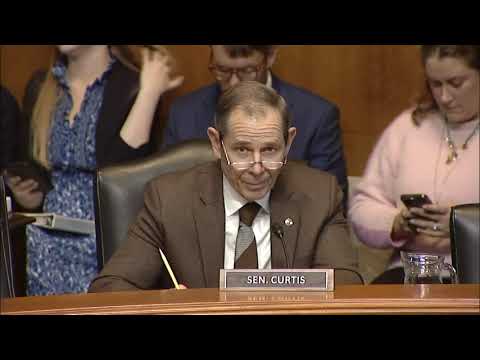
Senator Curtis presses witnesses on streamlining carbon-capture permitting under USE IT Act
Summary
At a congressional hearing, Senator Curtis pressed agency witnesses on how to speed permitting for carbon-capture projects under the USE IT Act, highlighting a backlog of UIC Class VI well permits and calling for clearer EPA processes and more federal funding for states pursuing primacy.
Senator Curtis pressed agency witnesses at a congressional hearing on ways to speed permitting for carbon-capture projects and said the USE IT Act should be used to help states move faster on carbon management deployment. "I firmly believe our nation's energy security depends on what I call affordable, reliable, and clean energy," he said, tying carbon-capture deployment to broader energy and environmental goals.
Curtis asked how the administration can implement the USE IT Act and related measures so projects qualify for streamlined review under statutes like the FAST Act. He told witnesses that companies in Utah face delays obtaining federal approvals and asked specifically what steps could make permitting more efficient.
An agency witness urged greater transparency from the Environmental Protection Agency in how it applies its internal "crosswalk" when reviewing state primacy applications. The witness said the crosswalk can be useful but is currently opaque to states, with highlight markers returned to applicants without explanatory notes. "Making that a more transparent process, training that is for both states and EPA simultaneously on what the crosswalk's purpose is and how it's to be used, would be very helpful in speeding primacy," the witness said.
Mr. Connors told the committee that EPA regional offices have a significant backlog of well permits and that shifting review authority to states that have applied for primacy would reduce federal workload. He said, "If EPA were to grant Texas alone primacy, 35% of those applications would go to the state of Texas," and estimated that about 161 well permits were backlogged at regional offices. Connors argued that granting primacy to states already in the queue and giving certainty about expedited processing would encourage more states to seek primacy.
On funding, Connors said the Underground Injection Control program has existed for roughly 40 years but that, since EPA published Class VI rules in 2010, there has not been designated UIC grant funding specifically for Class VI implementation. "States are applying for and administering those Class VI programs really with their own state funding," he said, and added that additional federal resources to implement Class VI programs would be "extremely helpful."
Curtis asked the panel to press agency officials — including Mr. Zeldman, whom he mentioned by name — to prioritize implementation steps. The hearing concluded with Curtis thanking the witnesses and the chair and yielding his time.
The exchange focused on clarifying EPA procedures, reducing permitting backlogs, and securing federal support for state implementation of Class VI permitting; no formal votes or binding actions were recorded during the exchange.