Get Full Government Meeting Transcripts, Videos, & Alerts Forever!
Get email alerts on the Air Quality Utah topic
No spam. Unsubscribe anytime.
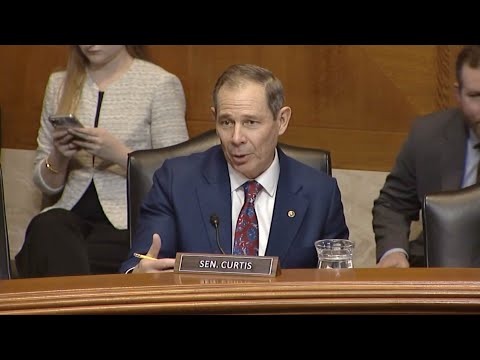
Senator Curtis presses EPA nominees for flexibility on Utah ozone, warns of Uinta Basin impact
Summary
Sen. Curtis told EPA nominees that Utah’s geography means the state controls only about 20% of local ozone and asked for regulatory flexibility after a recent EPA nonattainment action affecting the Northern Wasatch Front and Uinta Basin. Nominees Zabel and Fattuhi pledged to work with Utah officials.
Senator Curtis challenged two EPA nominees during a confirmation exchange, saying Utah’s unique geography limits the state’s control over ozone and asking the nominees to give Utah "flexibility" in enforcing federal standards.
Curtis said Utah controls “only 20% of the ozone in the area” and asserted that "approximately 80% of our ozone come from ozone emitting from the earth surfaces or from outside of the region," framing the state's air-quality problems as driven largely by factors beyond state control. He said Utah’s air has improved because of local commitments and investments but argued a recent EPA decision to redesignate the Northern Wasatch Front and Uinta Basin as nonattainment would have "significant impact economically, and otherwise for our area."
Curtis asked the nominees, "if confirmed, can we count on this flexibility and working with reasonable administrators to follow their lead in dealing with these tough issues?" He also urged the agency to avoid overly prescriptive rules that dictate specific technologies and instead focus on outcomes.
Mr. Zabel, speaking for himself, said in his current role and if confirmed he would "work with the state of Utah as well as all the states on their unique issues, but specifically Utah's as well." Mr. Fattuhi reiterated support for a balanced approach, saying he would work to protect air quality while also supporting economic development and growth in affected communities.
Curtis raised that small suppliers in the Uinta Basin have struggled to meet methane regulations not because of unwillingness but for lack of resources, and he asked the agency to be flexible about how regulated parties meet environmental goals. Both nominees gave verbal commitments to work with regional administrators and state officials.
The exchange concluded without a formal vote; Curtis said he would "use this pulpit to be really tough" if progress did not follow and yielded his time. The hearing moves on to other topics and the nominees’ full record and any formal actions will be part of the confirmation process.