
Clarksburg council weighs $150 initial rental-inspection fee, new collection powers for unpaid code fines
Get AI-powered insights, summaries, and transcripts
Subscribe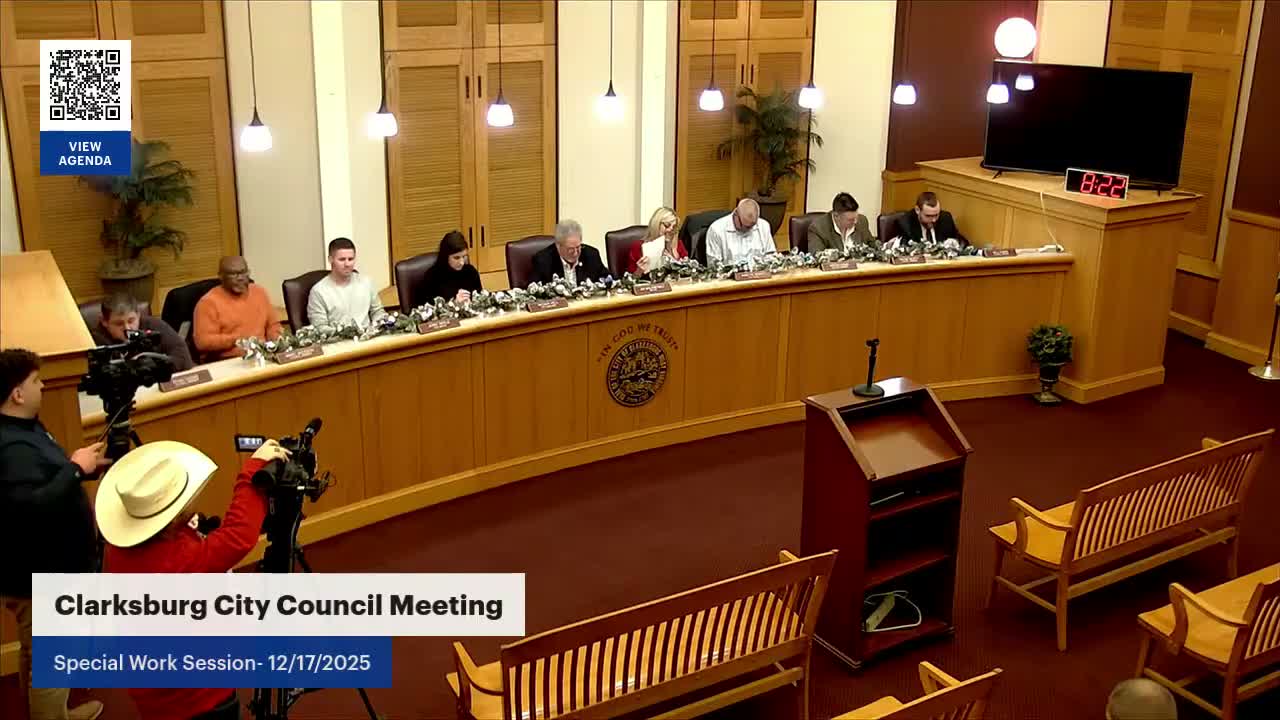
Summary
City council members debated a three-part 'Connect at Clarksburg' proposal to restrict multiunit conversions, require inspections of roughly 943 rental properties and allow unpaid code fines to be placed on property tax bills; staff estimated the inspection program could generate about $186,000 and named an interim code director for 90 days.
Clarksburg City Council on Monday discussed a package of measures aimed at improving housing conditions and bolstering code enforcement, including a proposed $150 initial inspection fee per rental unit and a legal change to allow unpaid code fines to be added to property tax bills.
The council heard a presentation on three related proposals under the "Connect at Clarksburg" initiative. The presenter said the city has identified 943 single-family structures used as rentals and estimated roughly 1,240 rental units once multiunit conversions are included. To create a robust records system and fund life-safety inspections, the proposal calls for a $150 initial inspection per unit (which the presenter said would include one inspection and one return visit), $30 for additional visits and a recurring inspection fee described in the presentation as "$50.50" every second year. The presenter described the $150 charge as cost-recovery and estimated the program could generate approximately $186,000 to pay for records management, administration, enforcement and legal costs.
The package would also limit changing single-family lots into multiunit rentals without planning-and-zoning commission approval. The presenter said the restriction would let the city pause new conversions while staff verify whether existing multiunit arrangements were properly authorized under past zoning.
Council members supported targeting repeat offenders but pressed for protections for well-maintained rentals. One councilor urged a sliding fee scale so landlords with few or no violations would not be disproportionately charged, while repeat violators would pay more. Another member warned the program must be structured so cost recovery remains viable.
On collections, the council discussed proposed legislation to allow unpaid code enforcement fines, penalties, fire fees, nuisance-abatement and demolition costs to be placed on property tax bills and collected by the county; the presenter said the draft includes a 2% county collection fee on amounts added. Members and staff raised enforcement challenges, noting property owners sometimes use LLCs or have out-of-state addresses that complicate garnishment or lien remedies. One speaker discussed abstract-judgment approaches as a possible supplement to liens.
Staff said the code office is short-staffed and that the city has started modernizing procedures: a cloud-based GIS heat map tied to code complaints is in development with Harrison County mapping staff, and the city is implementing standardized closeout forms and daily time audits for code officers. The presenter said "Steve Police" has been appointed interim director of code for 90 days to identify inefficiencies; council asked staff to confirm whether any director appointment will comply with state licensing requirements.
Speakers framed the package as protecting renters and homeowners while holding negligent property owners accountable. The presenter said fees would be dedicated to code enforcement functions rather than the general fund. Several council members asked staff for further detail — including a sliding-scale proposal, clearer language on who bears responsibility for nuisance items and whether HUD- or Section 8–subsidized properties have overlapping inspection responsibilities — before the measures are advanced.
The council did not adopt final legislation at the meeting; staff were asked to return with more precise cost models, proposed sliding-scale language and confirmation of collection mechanics and licensing implications.
The council had earlier moved into executive session to discuss personnel matters and adjourned the work session by voice vote at the end of the meeting.