Get Full Government Meeting Transcripts, Videos, & Alerts Forever!
Get email alerts on the Resilience Collaborative topic
No spam. Unsubscribe anytime.
Charleston County committee frames resilience work after symposium, sets collaborative for Feb. 12
Summary
After a symposium attended by more than 180 people, the Charleston County resilience committee announced a resilience collaborative to launch Feb. 12 to coordinate municipal efforts, share an inventory of 300+ resilience initiatives and develop shared solutions.
The Charleston County Resilience & Sustainability Committee on a December meeting recapped a recent county symposium that drew broad participation and announced the launch of a formal resilience collaborative in February.
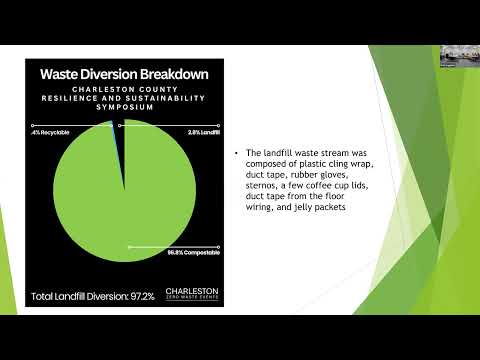
"We had over a 180 attendees," said Speaker 2, summarizing turnout that included representatives from more than 60 organizations and 10 of the county's 16 municipalities. Speaker 2 also reported the event achieved a 97.2% landfill diversion rate by prioritizing composting and reusable materials.
Why it matters: committee members said the symposium demonstrated where municipal efforts overlap and where gaps remain, and they proposed moving from a one-off event to an ongoing, structured forum. Speaker 2 said the resilience collaborative — scheduled for Feb. 12 — will provide "a space and actually, like, a structure, infrastructure for local government practitioners to connect, coordinate, and innovate" and will use a resilience inventory of roughly 300 programs, projects and plans to identify priorities.
Committee discussion focused on how to make the work accessible to residents: several members suggested alternating a public-facing symposium with smaller, topic-specific events held within individual municipalities so local audiences can engage on coastal flooding, tree ordinances or other place-based issues. Members stressed that recurring events will require line items in budgeting to ensure continuity.
New staff involvement and partnerships were also highlighted. Christophe Hassell introduced himself to the committee as a recent addition to the team and said he is currently completing a master’s degree in Charleston. Speaker 7 described the symposium’s zero-waste effort, noting coordination with Charleston 0 Waste and Trident Technical College to set up separate waste streams and back-of-house composting procedures.
Next steps: the committee will circulate the resilience inventory publicly once it is merged with existing Airtable records so municipalities and practitioners can filter by priority areas; an email announcing the collaborative date will be sent to members. The committee also discussed holding smaller local events to continue public engagement ahead of the formal Feb. 12 collaborative meeting.