
Eaton County equalization director reports rising assessed values; commissioners raise data‑center and solar concerns
Get AI-powered insights, summaries, and transcripts
Subscribe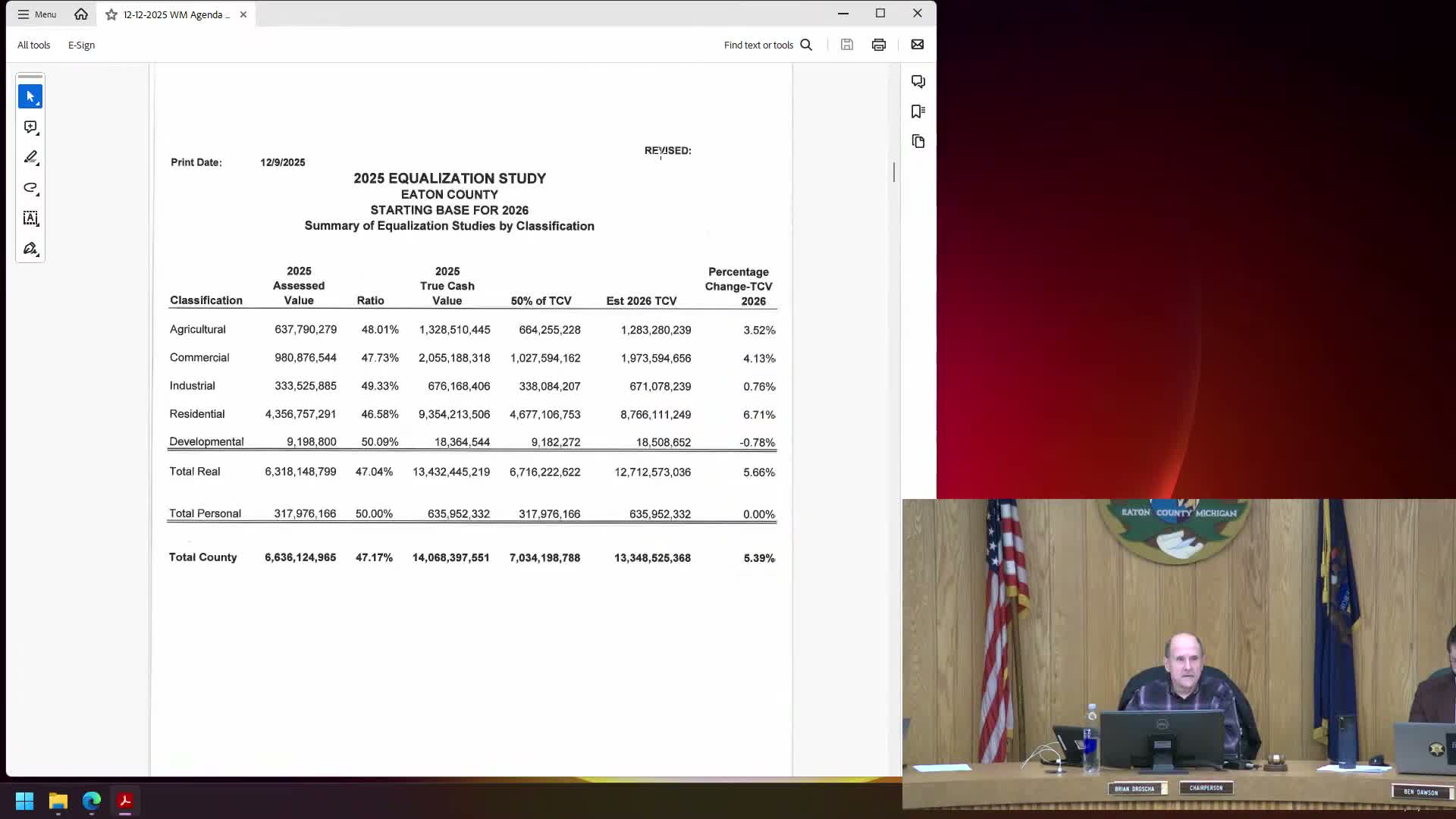
Summary
Equalization director Tim reported countywide assessed value increases for 2026 (overall SEV up ~5.66%; residential +6.71%), noted limited remaining development parcels in Delta Township, and warned sales of solar and data centers can skew agricultural valuations; commissioners asked about local zoning and potential negative effects on surrounding SEV.
Tim, Eaton County’s director of equalization and property description, presented the annual equalization study to the Ways & Means Committee, reporting rising assessed values across classes and describing how atypical sales — including solar project purchases and data‑center transactions — influence appraisal work.
Tim said countywide increases in assessed value included: agriculture +3.52%, commercial +4.13%, industrial +0.76%, and residential +6.71%, producing an overall real property increase of about 5.66% and an estimated assessed SEV change of roughly 5.39%. He emphasized that assessed value changes do not directly translate into identical tax increases because taxes are governed by state caps and other mechanisms.
On agriculture, Tim listed township‑level changes (examples: Bellevue +9%, Eaton Rapids Township +9.9%, Sunfield large swings), and said some high‑value solar and large‑farm purchases were excluded as outliers from averages because they would distort typical market measures. He noted only a small number of developmental parcels remain in Delta Township and that protections and minimum acreage rules apply in some areas.
Commissioners asked how data centers and solar projects affect valuations and whether they could lower nearby SEV. Tim said data centers can bring tax revenue and limited jobs but also risk negative local valuation impacts if siting is inappropriate; he recommended careful zoning, buffers, and planning to reduce potential negative neighborhood effects.
The committee did not take action; Tim said the appraisal study would continue to be refined and used in equalization work for the coming tax year.