
Chesterfield staff: school enrollment roughly flat, utilization about 91%; planned capital drops utilization into mid‑80s
Get AI-powered insights, summaries, and transcripts
Subscribe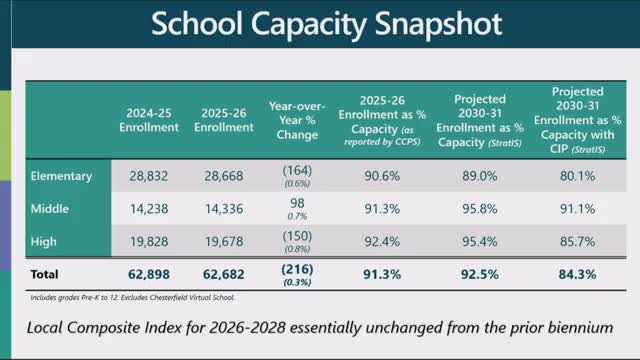
Summary
County and school staff presented Sept. 30 enrollment counts and Stratus five‑year forecasts showing modest decline this year (216 fewer students) and system utilization around 91%. With planned referendum projects and two elementary additions, system utilization would fall into the mid‑80s.
County and school staff presented enrollment forecasting data using the Sept. 30 headcount and a five‑year Stratus model, reporting a net decrease of 216 students for the current year and system utilization at roughly 91 percent.
“September 30 is a big day for school enrollment,” Mr. Harris said, explaining the count is the benchmark for multiple operational and planning models. He described how schools run near‑term cohort survival forecasts for staffing and how the county runs the Stratus model with a housing‑pipeline overlay to project capacity and demand five years out.
Staff showed maps and level‑by‑level analyses: elementary, middle and high school tiers each have different pressure points. Presenters said existing and planned capital investments — including two elementary schools currently planned and a new high school with roughly 2,400 seats (Cosby) — would reduce system utilization to the mid‑80s if built and brought online as scheduled. Without capital interventions, some grade levels would remain in the low‑90s utilization range.
Board members and staff discussed local redistricting options to move students between over‑ and under‑utilized campuses and noted modular trailers are not counted toward program capacity in the Stratus forecasts; presenters cautioned that redistricting decisions are politically sensitive and can prompt legal challenges.
Presenters highlighted localized pressure points (for example, Tomahawk Creek has substantial unused capacity adjacent to schools with overcrowding) and said about 3,000 elementary seats are planned to come online through CIP projects, which would materially shift utilization at the elementary level.
What’s next: staff said they will continue to refine Stratus projections and coordinate with the school division and planning commission as CIP decisions and potential redistricting are considered in the coming budget season.