
Hillsborough board advances tobacco-free policy, asks staff to reconcile vaping sensors with student code of conduct
Get AI-powered insights, summaries, and transcripts
Subscribe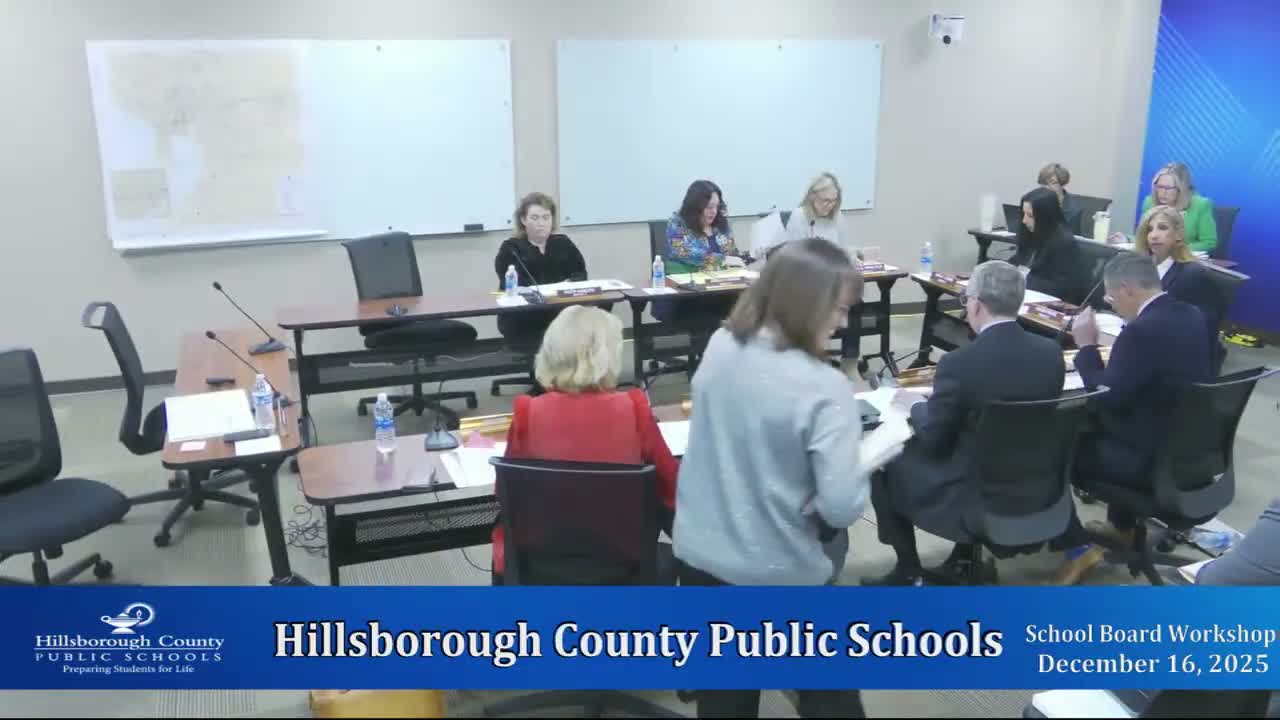
Summary
The Hillsborough County School Board agreed in workshop to send a revised tobacco-free environment policy (55.12) to public hearing after asking staff to add statutory-compliant buffer language, refine definitions, clarify signage and align consequences with the student code of conduct; board also requested a written plan for classroom deployment of Halo vaping sensors now piloted in high schools.
The Hillsborough County School Board on Dec. 16 directed staff to prepare a revised tobacco-free environment policy for public hearing after extensive discussion about vaping detection technology, disciplinary consistency and signage.
Member Gray introduced Policy 55.12 as a districtwide tobacco- and vaping-prohibition. Member Rendon asked the policy to include a 1,000-foot buffer from any school or Hillsborough County school property and recommended removing the policy’s enumerated disciplinary range so consequences would be set by the student code of conduct. "I would ask that in the general statement of the policy, we include, the thousand feet from any school or Hillsborough County School property," Rendon said.
Staff reported the district piloted three vendors and selected the Halo sensor produced by Motorola for high-school bathroom deployment. "They will be installed in all the high schools this spring," said the staff presenter, who described the rollout as capital-funded and tied to hallway cameras to help identify students near an activated sensor.
Board members pressed staff to clarify several practical points before a public hearing: whether pilot schools should be temporarily treated differently, how device-detected events will translate into discipline, whether signage should read "no smoking or vaping" or "no use of tobacco products," and whether the proposed 1,000-foot buffer complies with state law. Several members said the student code of conduct should be the definitive source for penalties rather than listing specific sanctions in the policy.
Staff agreed to (a) draft temporary language addressing how pilot-device detections will be handled and explicitly tie consequences to the student code of conduct, (b) examine and propose statutory-compliant 1,000-foot language, (c) combine overlapping definitions where legally permissible, and (d) propose consistent signage wording. With those edits, the board reached consensus to move the policy to public hearing.
The board did not take a formal roll-call vote in the workshop; the item will return at public hearing after staff incorporates the requested edits.
What’s next: Staff will return the revised policy and proposed signage language in time for public hearing. The board asked for data from the Halo pilot before a districtwide deployment decision.