Get Full Government Meeting Transcripts, Videos, & Alerts Forever!
Get email alerts on the Allowable Expenses topic
No spam. Unsubscribe anytime.
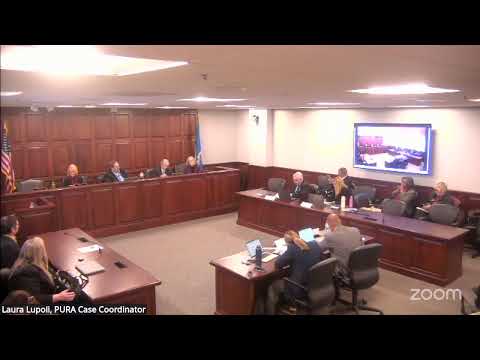
PURA's expense panel grills Hazardville Water on chemical costs, related-party rent and payroll reconciliations
Summary
During O&M questioning PURA staff flagged a near-45% proposed increase in chemical costs (company said timing and unit misclassification partly explain the gap), identified lease payments to a parent-owned real-estate company and requested the lease document, and probed payroll allocations and board/D&O charges; staff issued multiple read-ins and late-file requests to reconcile invoices and pro forma adjustments.
PURA staff and OCC spent significant time examining operation and maintenance expenses, focusing on three areas that could materially affect the revenue requirement: chemical treatment costs, related-party lease payments, and payroll allocations.
Chemicals: Staff identified large increases on Schedule C-3.11 and asked why the company proposes nearly a 45 percent increase in several chemical line items for the rate year. The company explained the test year appeared artificially low because of purchase timing (some quantities bought late in the prior year), and acknowledged at least one worksheet line used pounds where gallons should have been reported. PURA entered a read-in (RU96 Worksheet Cell J72) asking the company to provide corrected gallon values and to update RU127 with historical unit costs back to the last rate case (Late-file 35).
Related-party rent: Staff examined financial statements showing Illinois Real Estate (a parent-affiliated entity) owns the building at 41 Taylor Road and that Hazardville paid $99.41 per month effective in 2025 (about $108,000 for 2024 after allocation). Staff requested a copy of the lease agreement and agreed to a read-in locating that document (Read-in U); the company indicated it had provided the lease as OCC113a but agreed to confirm the record location.
Invoices and amortization: Staff asked for invoices supporting a $16,008.71 Deep expense and why that amount was included in an amortization schedule rather than as a regular O&M expense. The company acknowledged the distinction and agreed to a read-in and/or late-file explanation. Staff also requested supporting invoices for maintenance categories (RU99 supplements) and asked the company to explain year-to-year fluctuations in SCADA, pump maintenance and meter-reading expenses (Read-in V and Late-file 33).
Payroll and board matters: Staff and OCC focused on payroll coding and reconciliation to federal quarterly filings (941s). Company acknowledged a $1,400 overtime item that had been mischaracterized and said it would be reflected in a LFE1 adjustment. OCC probed recent turnover in accounting roles and asked whether the company had made commitments to new hires; the company said no legal guarantees were in place. Staff also discussed directors' and officers' liability insurance and whether a portion of such coverage benefits ratepayers or the company, and the company said it benefits both but could not quantify a split.
Next steps: The company agreed to multiple read-ins and late-file exhibits (including corrected chemical unit data, invoices for Deep and other vendors, propane/fuel inventory reports for the last six months, and reconciliation of payroll projection differences). Those filings will be used to determine whether to pro forma adjust test-year expenses and whether any items should be amortized or treated as yearly O&M expenses.