Get Full Government Meeting Transcripts, Videos, & Alerts Forever!
Get email alerts on the Rate Case Overview topic
No spam. Unsubscribe anytime.
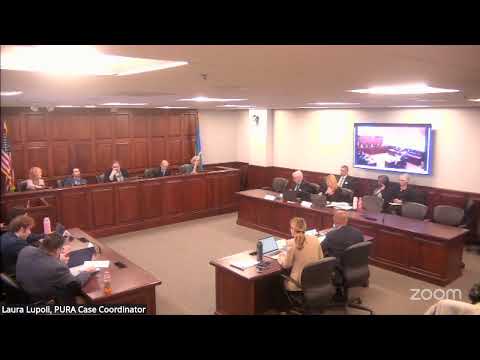
PURA opens evidentiary hearing on Hazardville Water Company rate application; panel orders multiple late‑file exhibits
Summary
Interim Chair Tom Wheel convened PURA’s evidentiary hearing on Hazardville Water Company’s request to amend rate schedules (docket 25‑0712). The panel swore company witnesses, flagged multiple supporting documents as late‑file or read‑in exhibits and set follow‑up deadlines; hearings continue tomorrow at 10 a.m.
Interim Chair Tom Wheel opened the Public Utilities Regulatory Authority hearing on docket 25‑0712, noting the agenda and listing the commissioners present. He disclosed prior limited involvement in a preliminary meeting relating to this case and invited parties to raise recusal concerns; none objected.
Hazardville Water Company entered appearances through attorneys David Bogan and Colleen Olson. Company witnesses Robert Sherwood, president and CEO, and Jennifer Wright, chief financial officer and treasurer, were sworn and adopted their filed testimony. The Office of Consumer Counsel appeared through Alison McCormick, Andrew Monikowski and Prabisha Bandari.
PURA staff began cross‑examination focused on the company’s schedules supporting its rate request, particularly Schedule C‑3.81 (deferred and amortized expenses). Staff asked for exhibit support for a proposed $186,400 rate case expense and pressed for backup on deferred sales and use tax balances, storm restorations, vendor invoices and allocation of shared consulting costs. Where documentation was incomplete or questions required historical reconciliation, the chair directed a set of read‑ins and late‑file exhibits (numbered by the chair) so the company can supply underlying invoices, reconciliations or narratives.
Key technical topics flagged for follow‑up included: reconciliation of amortization shown in the prior rate case and the present filing (read‑ins to prior dockets were ordered), the company’s treatment of sales/use tax and whether returns exist for periods of requested recovery, the nature and documentation of consultant invoices (including invoices attributed to a consultant named Bob Flagg), and the reconciliation between insurance payments and claimed storm losses.
PURA’s engineering staff also questioned several capital‑project entries in the company’s pro‑forma schedules. Among items discussed were a 2015 summer‑tank study and a new million‑gallon storage tank project (the company said the 300,000‑gallon tank will be removed from service once infrastructure improvements and the new tank are complete), a Copper Street main replacement that the company reported was completed in 2024, and a backlog of plant additions and construction‑in‑progress amounts the authority asked the company to update with percent‑complete and in‑service status.
On water quality, the company confirmed PFAS detections at two wellfields and said it is working with an engineer and has applied to the Department of Public Health (DPH) for state revolving fund assistance; the company noted the regulatory horizon for PFAS removal and that it will seek funding and technical options. The company also outlined its lead‑service‑line identification efforts, reporting roughly 130 unknown company‑side services and noting a regulatory identification deadline for customer notification.
The hearing record includes a long list of directed read‑in items (documents to be read into the record) and late‑file exhibits the company must produce with more detailed backup. Chair Wheel closed the panel and scheduled continuation of the hearing for the next day at 10:00 a.m. for redirect and follow‑up on the ordered filings.
The proceeding remains evidentiary; no final votes were taken on policy, rates or approvals during this session. Next procedural step: company to file the requested read‑ins and late‑file exhibits and PURA will reconvene for continued cross‑examination and redirect.