Get Full Government Meeting Transcripts, Videos, & Alerts Forever!
Get email alerts on the Cost Of Capital topic
No spam. Unsubscribe anytime.
PURA continues Hazardville Water rate hearing as staff presses company on swap, financing and performance adder
Summary
On Day 2 of the Public Utilities Regulatory Authority hearing, commissioners and staff questioned Hazardville Water Company witnesses about the embedded cost of debt (a disputed 3.96% figure), how an interest-rate swap affects the company's loan costs, an anticipated $3.9 million construction loan and whether the company merits a 50-basis-point ROE performance adder. PURA staff issued multiple late-file and read-in requests to clarify calculations and supporting documents.
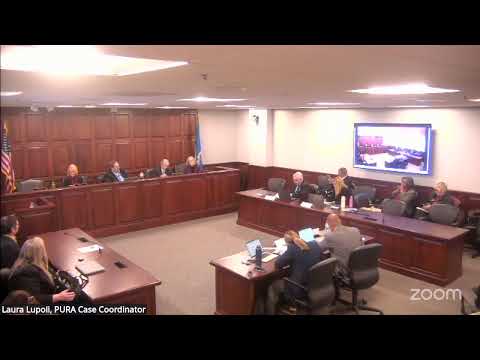
The Public Utilities Regulatory Authority (PURA) reconvened an evidentiary hearing on the Hazardville Water Company rate case for a second day and spent much of the morning testing the company's cost-of-capital claims and accounting treatment of recent financings.
Authority staff asked the company to explain a line in testimony that states the company's embedded long-term cost of debt is 3.96 percent as of Aug. 1, 2025. Jonathan Norton of PURA staff said the percentage appears higher than the interest rates listed on Schedule D-1 and asked whether the company had included all long-term financings and the effects of an interest-rate swap in that calculation. "In the company's testimony filed 08/06/2025 ... the company's embedded cost of long term debt is 3.96%," Norton said at the hearing.
Company witnesses confirmed the swap is recorded and said they generally use the fixed leg of the swap (3.76 percent) when calculating interest expense; they also agreed that net receipts from the swap reduce the effective cost of the construction loan. The company witness summarized the accounting treatment: "We pay whatever the variable rate is to the bank ... and then we receive the spread the difference," and the company books the net effect monthly while auditors record the other-comprehensive-income adjustments at year end.
Because the precise net effect changes the numerator for a cost-of-debt calculation, staff asked the company to file a late-file exhibit showing a pro forma calculation of the 2.5 million dollar construction loan that incorporates the swap's cash flows from the commencement of the loan term (Late-file 24). Staff also requested finalized loan terms and related loan documents (Late-file 25) and an updated Schedule D-1 showing the expected average carrying balances and interest owed/received for each financing (Late-file 26).
The panel also spent time on a planned near-term financing of roughly $3.93 million that company testimony shows would move the pro forma capital structure toward about 43.45 percent equity. Staff asked whether the company expects to pay down existing debt with the new loan; the company said it does not. Commissioners questioned whether PURA should set the capital structure for the pro forma year based on that realistic expectation; company witnesses said the figures should be time-aligned and agreed to provide clarifications in late files and read-ins (Late-file 27).
Separately, PURA staff and the Office of Consumer Counsel pressed the company about a requested variable "performance" return-on-equity adder that stems from the agency's small-water-company streamlining docket. Staff requested examples and narrative support of any "exemplary performance" claimed in this filing, and the company agreed to provide examples in Late-file 28. Attorney Richard Sovalewski of the OCC questioned whether capital projects alone should support a performance adder, noting that regulated utilities already recover a return on plant in service.
No formal decisions were made during the session. Chair and counsel set deadlines for the many read-ins and late-file exhibits staff requested, and the hearing recessed to continue the allowable-expenses panel after lunch.
What comes next: PURA staff and intervenors will receive the late-file exhibits and read-ins scheduled during the hearing, including the company's calculations showing the swap's effect on the 2.5 million dollar construction loan and the bank amortization tables the staff requested to compute pro forma interest for the upcoming rate year.