
Hopkinton leaders review superintendent’s FY27 school budget; $71.8M operating base and $322,000 gap reported
Get AI-powered insights, summaries, and transcripts
Subscribe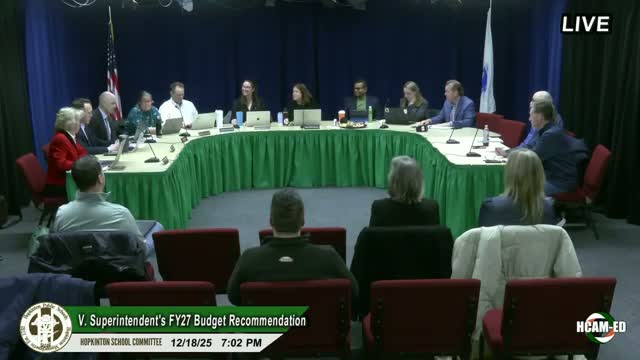
Summary
School leaders reviewed the superintendent’s recommended FY27 budget, which folds a $1.09M special-education reserve into the operating base and proposes roughly $535,000 in new staffing requests. Presenters said the net operating budget for FY27 would be about $71.8 million with a current $322,000 deficit.
The joint Hopkinton School Committee and Select Board reviewed the superintendent’s recommended fiscal year 2027 budget on Dec. 18, with presenters laying out a $71,836,488 net operating budget and a series of staffing requests aimed at special education, enrollment growth and core operations.
The presenter said the budget-building process began in late summer and included capital planning, principal and department leader presentations, and town-level coordination; a public hearing is scheduled for Jan. 8 and the school committee vote is expected Jan. 22. The presentation noted the district’s operating budget averaged roughly a 5.84% annual increase from FY20 to FY26 and that two items — a special-education reserve (about $1.09 million) and required financial software — have been folded into the FY27 operating base, adding roughly 1.7 percentage points to the starting figure.
Why it matters: officials said moving the special-education reserve into the operating budget changes how the increase is presented and prompted questions from board members about taxpayer implications. One board member summarized the concern as a town-accounting nuance: the reserve was previously paid with free cash; bringing it into the base operating budget makes the percentage increase appear higher or shifts levy accounting in ways that may confuse residents.
Key figures and staffing requests: presenters described current preK–12 enrollment at about 4,237 (end of 2024–25) with projections of 4,377 for June 2026 and 4,532 for June 2027. The district reported roughly 602 educators, including about 370 classroom teachers, and an overall student–teacher ratio near 14:1. New requests total approximately $535,000 (with about $88,000 already approved by the school committee). Specific staffing asks outlined included:
- A second intensive special-education teacher at Hopkins to align intensive supports across buildings. - Two paraprofessional positions (approved for midyear hires): one at the middle school and one at Marathon School to meet IEP commitments. - Additional related-arts or instructional staff at the middle school to address a cohort “bubble” that could otherwise raise class sizes into the 30s. - Hosting responsibilities for the gymnastics co-op (estimated incremental cost ~$15,000) after the host school withdrew. - A 1.0 reading interventionist (proposed) intended to serve approximately 10–20 students per grade and provide Tier 1 supports. - A 0.5 ESOL position at Marathon to provide earlier language support. - A full-time assistant principal at the high school to reduce AP caseloads (presenters said current caseloads are about 650 students per AP versus a target of roughly 450). - One additional custodian to address increasing square-footage and cleaning needs as new construction adds space.
Budget arithmetic and offsets: finance staff explained the FY26 reported budget with the special-education reserve included equals $67,869,655 and that the FY27 net operating request reflects contractual salary increases (roughly $3.13 million), staff-requested positions ($535,000), and an expense increase of about $297,000. The presenters also described revenue offsets: an increase in circuit-breaker reimbursements (a one-time transportation-related adjustment of $415,220 was cited) and reallocation of IDEA grant funds into expense lines rather than salary. Finance staff cautioned that circuit-breaker reimbursements are not guaranteed and have historically ranged roughly 60–75% depending on state funding levels.
Board questions and concerns: members asked how the reserve shift affects the apparent percent increase and taxpayers’ levy expectations. One participant framed the change as a town-accounting move: "this is a little bit of a town accounting thing where we're moving a line item from one place to the other," and presenters confirmed it was previously funded with free cash. Remote participant Mister Kisner asked presenters to clarify which salary increases are contractual versus elective; finance staff said roughly 85–86% of the increase is contractual. When asked for the near-term funding gap, finance staff said the current proposal shows a deficit of $322,000.
Next steps: the presenters said they will post the presentation on the district website, hold a public hearing on Jan. 8, and bring the budget to a school committee vote on Jan. 22 before the town meeting in May. The joint meeting concluded the budget portion after a procedural motion and agreed to move on to appropriations and capital updates.