
PURA probes Hazardville Water Company late‑file rate exhibits; staff orders supplements on legal, tax and project support
Get AI-powered insights, summaries, and transcripts
Subscribe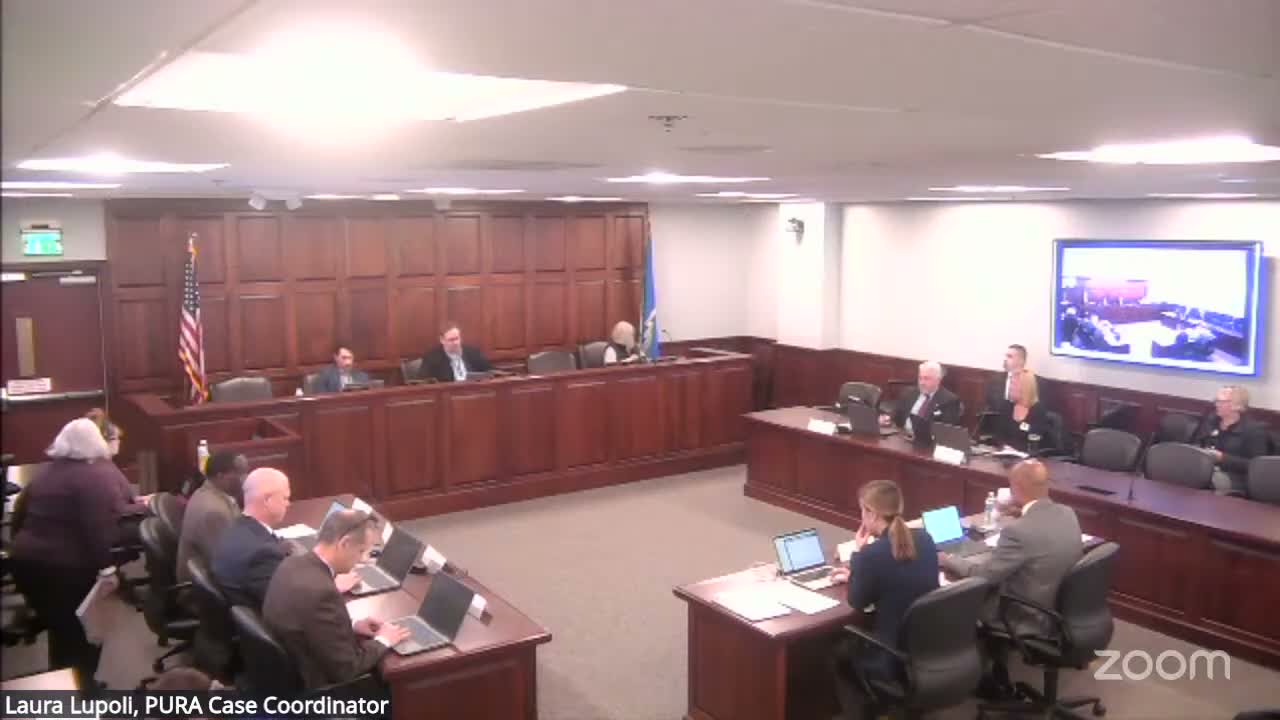
Summary
At a late‑file hearing, the Public Utilities Regulatory Authority pressed Hazardville Water Company for evidence supporting higher legal fees, sales‑and‑use tax allocations, developer‑funded projects and other late exhibits; the authority ordered several supplements and read‑ins and left some submissions to be filed before the record closes.
Interim Chairman Tom Wheel presided over a late‑file hearing on Hazardville Water Company’s request to amend its rate schedules, pressing the company for documentation to support several late exhibits and accounting changes.
The hearing focused on a cluster of evidentiary gaps staff said are material to the company’s revenue request. Authority program staff asked the company to supply invoices and returns to justify an increase in estimated legal expenses from roughly $84,000 in the original filing to $150,000 in a late exhibit; company witness Jennifer Wright said unbilled legal work and higher-than-expected attorney fees explain the difference and that legal fees to date are about $77,000 with another $70,000–$75,000 anticipated. Chair Wheel directed the company to supplement the record with supporting invoices and the basis for the unbilled estimate.
Staff also challenged tax and historic‑project support. Bakari, questioning the company’s late filings, asked for sales and use tax returns tied to specific Excel rows cited in LFE‑3; staff said the company must file those tax returns so the authority can confirm the pro forma entries. The company agreed to provide the returns as a supplement.
The panel spent significant time reviewing past rate‑case treatment of a 2007 water‑supply plan item (roughly $14,311) and its amortization. Staff noted a $2,862 annual amortization line appears to have been included in a prior docket’s amortization total; the company said some related documents are in the admitted evidence filing dated 11/25/2025 but that it would search for additional attachments and offer a read‑in to clarify whether the cost was previously recovered.
Procurement and capital projects drew sustained scrutiny. Commissioners and staff walked through a detailed late‑file asset list and asked why developer‑installed mains show up in the company’s plant schedules and whether contributions in aid of construction were netted out as offsets in the company’s B schedules. The company acknowledged it needs to verify accounting entries and agreed to provide supporting docket numbers and documentation (the chair noted Summersville acquisition docket 870719 as a read‑in). The Cooper Street project was cited as an example: a single bid and a later change order for an unexpected 60‑foot extension and pavement restoration raised questions about bid solicitation and change‑order controls; company witnesses said small projects sometimes proceed after informal outreach when contractors cannot meet tight schedules, and engineers handle competitive bidding for larger projects.
On system accounting, staff and counsel examined how the company treats Ryhill (Rye Hill) — customers are billed at Connecticut Water retail rates while Hazardville pays Connecticut Water a commercial purchase rate. Company witnesses testified they had removed Rye Hill revenue and purchase‑water expense from pro forma schedules and currently do not separately track incremental Rye Hill operating costs; staff requested read‑ins showing whether annual reports or other filings break out Rye Hill costs and revenues.
Water quality and operational items were also on the record. The company reported the Grama well remains offline; staff asked about PFAS testing and EPA timelines and were told the well will be tested for PFAS before any reactivation and before the applicable EPA deadline if it remains a candidate for service. Staff questioned a roughly 44.5% adjustment to chemical costs (LFE‑35); the company responded that test‑year purchasing patterns depressed the test‑year amount and that the late‑file adjustment normalizes to a recent multi‑year average (company said it used a shorter 2–5 year lookback rather than a 15‑year average staff used as a comparator).
Company financing and cost‑of‑debt entries were examined in detail. Staff asked how the company calculated its reported embedded cost of debt (the company adjusted a prior calculation after discovering an annualization error and explained it had recalculated using a seven‑month basis to match outstanding balances as of July 31, 2025). The company also discussed an interest‑rate swap that it said effectively fixes part of a loan at about 3.76%; staff asked for supporting swap documentation and for clarity on swap accounting and treatment.
Rate design drew questioning near the end of the hearing. The company proposed an inclining‑block design (step points expressed in the filing as 10 units monthly / 30 units quarterly) and an effective step of roughly 55% (reverse of the company’s historic commercial declining‑block differential). Intervenors and staff tested alternate breakpoints (for example 25/75) and discussed the practical effects on high‑use accounts and revenue neutrality; the company said it could implement a revenue‑neutral block structure if ordered in a final decision and that conservation responses to price signals could change realized revenue impacts.
Procedurally, the authority flagged multiple read‑ins and supplements. The chair instructed the company to file supporting exhibits and read‑ins (for example sales and use tax returns, legal‑fee backup, Summersville docket references, cooperative allocations and swap documentation) before the record closes; parties were told materials filed after the close will be subject to objection and given only such weight as the authority decides. The bench closed the session and announced Monday’s continuation was canceled.
What’s next: PURA ordered specific supplements and read‑ins (several were captured on the record); the company agreed to provide additional documentation. The authority will consider the late materials and parties’ objections, and the evidentiary record will close on the schedule announced by the chair.