Education Department outlines sweeping student‑loan rule changes at RISE negotiated rulemaking
Loading...
Summary
Department officials opened the RISE negotiated rulemaking and described major regulatory proposals from a recently enacted education package: simplification to two repayment choices, a new Repayment Assistance Plan (RAP) with a $10 minimum payment, new institutional loan limits, and changes to rehabilitation, forbearance, and consolidation rules.
The U.S. Department of Education opened its RISE (Reimagining and Improving Student Education) negotiated rulemaking by laying out the department’s plan to implement major changes to federal student‑loan programs under recently passed legislation. Department officials said the goal of the rulemaking is to simplify repayment, limit excessive borrowing, increase institutional accountability, and align federal aid more directly with student outcomes.
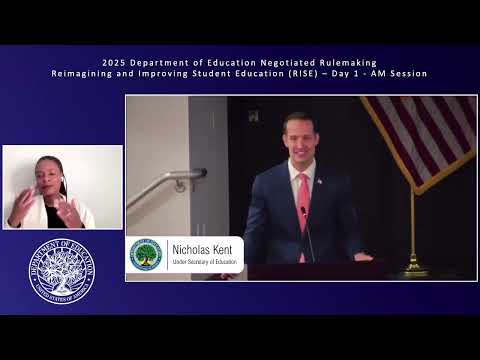
Undersecretary Nicholas Kent told negotiators that the federal student‑loan portfolio “stands at a staggering $1,700,000,000,000,” and said the rulemaking is a moment to redesign a system the administration views as having “failed too many students for far too long.” Kent framed the package as delivering on reforms that include expanded Pell funding, responsible borrowing limits, repayment simplification, and new accountability rules for institutions.
Tammy Abernathy, director of the policy coordination group in the Office of Postsecondary Education, walked negotiators through the Department’s proposed regulatory approach under 34 CFR parts 674 (Perkins), 682 (FFEL), and 685 (William D. Ford Direct Loan program). Key elements the Department presented include:
• Repayment simplification: For direct loans made on or after July 1, 2026, borrowers would choose between a new “tiered standard” repayment plan and a new Repayment Assistance Plan (RAP). If a borrower does not select a plan for loans made on or after that date, the Department would assign the tiered standard plan by default.
• RAP features: The Repayment Assistance Plan sets a borrower’s monthly payment based on adjusted gross income, reduces that base payment by $50 per tax‑return dependent, includes a $10 minimum payment option, and creates a matching principal payment when a required payment does not reduce principal by at least $50. RAP forgiveness would occur after 360 qualifying monthly payments (30 years).
• Loan limits and institutional caps: The Department described new annual and aggregate loan limits for graduate and professional students, new annual limits for Parent PLUS borrowers, and authority for institutions to impose program‑level loan limits to curb excessive borrowing.
• Deferment, forbearance, and rehabilitation changes: For loans disbursed on or after July 1, 2027, unemployment and economic hardship deferments would no longer be available; forbearances for new loans would be limited to nine months in any 24‑month period. The Department proposed permitting borrowers to rehabilitate defaulted loans up to two times over the loan’s lifetime and setting the minimum rehabilitation payment at no less than $10.
• Consolidation and PSLF: Staff proposed changes to consolidation deadlines and eligibility that affect access to income‑based repayment plans and public service loan forgiveness (PSLF). The Department said RAP would be added as a qualifying repayment plan for PSLF purposes and reiterated that some earlier IDR variants will sunset by mid‑2028.
Department officials repeatedly cautioned negotiators that statutory effective dates in the legislation create a compressed implementation timeline and that many operational questions would require follow‑up from technical teams. The Department also noted it has published contingency plans should appropriations lapse and that it will release a Federal Register notice describing next steps and timelines.
The committee will continue detailed discussion of redline regulatory text in subsequent sessions; staff asked negotiators to submit alternative language and data requests electronically so the Department can circulate materials for the formal NPRM process.