Committee approves amended SoDo BIA assessment change after contested public hearing
Loading...
Summary
After a public hearing with industrial property owners and SoDo businesses expressing concern about formation and assessment increases, the committee adopted a technical amendment and voted unanimously to advance council bill 121,073 to full council, directing an OED study of government-owned properties.
The Governance, Accountability and Economic Development Committee unanimously recommended passage Dec. 11 of a revised ordinance to change how the SoDo Parking and Business Improvement Area assesses properties, after a public hearing that included complaints from industrial tenants and property owners.
Clerk read council bill 121,073 into the record: the measure would change the basis of assessment in the SoDo BIA from total taxable value to total appraised value, allow consideration of certain tax-exempt nonprofit and government-owned properties, and establish a fixed capture date for assessment data to reduce backbilling. The committee also considered a technical amendment to delay the ordinance’s effective date to mid-2026 so FAS (Finance and Administrative Services) can adjust billing processes.
Multiple speakers during the public hearing raised sharp concerns. Jodi Opitz, an industrial property owner, said formation petitions were signed largely by developer-owned LLCs and alleged conflict-of-interest and self-dealing optics; she urged disbanding the BIA under RCW 35.87A. Other speakers — including business tenants and owners — said sudden large assessment increases tied to institutional transactions could force rent hikes and closures for locally owned industrial businesses. "These are working warehouses, manufacturing spaces, and small businesses... A sudden tax increase of this magnitude will force rent hikes, layoffs, or closures," said Kelsey Levi, a SoDo business owner.
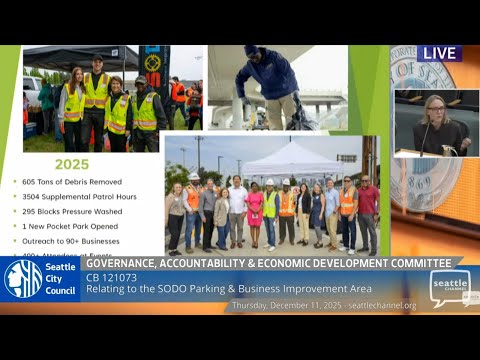
Erin Goodman, executive director of the SoDo BIA, described the district’s services and argued the amendment would help maintain core operations. "Our clean team has removed over 600 tons of debris from city streets. We've provided over 3,500 supplemental patrol hours," Goodman told the committee. Goodman said the proposed assessment change primarily affects seven properties and asked council to adopt the amendment and direct the Office of Economic Development to study government-owned properties that receive BIA benefits but are not currently assessed.
Council Central Staff explained that the amendment moves the assessment basis to total appraised value to align SoDo with other BIAs that use appraised value and creates a fixed capture date for assessment data to prevent mid-year adjustments. The amendment also delays the effective date to mid-2026 to avoid disrupting current billing.
Committee members emphasized the supplemental role BIAs play in providing services that often supplement city functions and discussed the need for stakeholder engagement. The committee voted 5–0 to adopt Amendment 1 (which sets the later effective date) and then voted unanimously to forward the amended bill to full council. The committee also directed OED to conduct stakeholder work and return with a proposal by July 1 addressing government-owned property assessment issues.