
PNC approves short-term rental language for county zoning, keeps two-per-block limit for now
Get AI-powered insights, summaries, and transcripts
Subscribe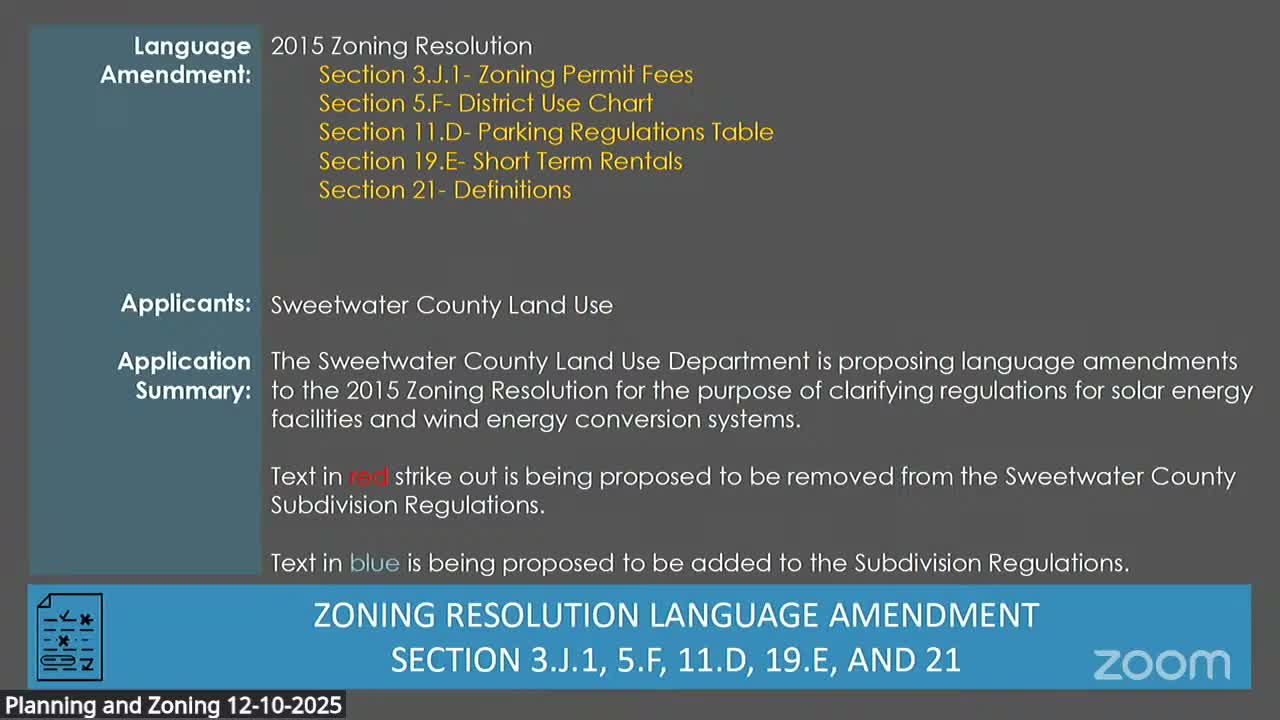
Summary
The Planning and Zoning Commission approved adding language to the Sweetwater County zoning resolution to regulate short-term rentals, including a $100 permit fee, 14-day neighbor notice, annual renewals, inspections by code and fire staff, and a density limit of no more than two short-term rentals per block; commissioners said density language will be refined case-by-case.
The Planning and Zoning Commission (PNC) voted to add proposed language to the 2015 Sweetwater County zoning resolution that would create a short-term rental permitting regime across the county, increase the zoning permit application fee and set operational conditions for short-term rental operators.
Land use staff (Speaker 4) told commissioners the package would amend sections on zoning permit fees, the district use chart, parking regulations, a new short-term rental supplemental use section and definitions. “So currently, we charge $50, and I’m proposing to bump that up to a $100,” Speaker 4 said, describing the fee as more consistent with other Wyoming counties.
The amendments would define short-term rentals as lodging for periods under 30 days (excluding home exchanges and subletting), require applicants to post a notice on the property with a 14-day period for adjacent owners to comment, and require a completed application, a $100 application fee and a signed inspection affidavit. Inspections would be performed by code enforcement and fire warden Allen Adams to verify compliance with the International Fire Code and basic safety standards, Speaker 4 said. “If there are no reasonable concerns after those 14 days, then the application can move on to be approved by the department,” Speaker 4 added.
The proposal also sets annual permit renewal with a $50 renewal fee and allows land use staff to delay or deny renewals for failure to timely renew, incomplete applications or valid written complaints. Applicants denied permits may appeal through the county’s appeals process.
The amendments list multiple conditions for approval adapted from conditional use standards, including compatibility with adjacent uses, mitigation of environmental impacts, adequate off-street parking tied to existing residential parking tables, collection and remittance of sales and lodging taxes, a prohibition on using tents or recreational vehicles as short-term rentals, and a requirement that operators designate a local property representative who is available 24 hours a day to respond within one hour to complaints (an initial acknowledgement is acceptable), Speaker 4 said.
One of the most contested provisions was a proposed density limit: “No more than 2 short-term rentals shall be permitted within 1 block on the same street in any residential zone,” Speaker 4 read. Commissioner Speaker 2 and others said that limit could unfairly prevent owners who rely on rental income from operating, arguing it could be punitive in subdivisions or smaller blocks. “That’s not fair,” Speaker 2 said, noting concerns about how the county would determine which properties qualify when multiple owners want to rent.
Commissioner Speaker 7 defended the limit as a tool to prevent neighborhoods from becoming dominated by vacation rentals, saying the language is intended to preserve residential character and that the rule could be adjusted after further review. Speaker 7 suggested exploring alternatives such as distance-based standards or subdivision-block definitions to better fit local lot sizes and rural contexts such as Manila and Rock Springs.
On enforcement, Speaker 7 explained the county’s revocation process: staff would notify noncompliant owners and provide a 30-day period to remedy violations; if problems persist the matter could return to the Planning and Zoning Commission and the Board of County Commissioners for public-hearing revocation, with neighbors notified.
There were no members of the public who spoke during the public-comment period on this item. After discussion, Speaker 3 moved to accept agenda item 1, including language amendments and the proposed section 15 density language; Speaker 1 seconded. The commission voted in favor and the motion carried; the chair directed staff to add the amendment to the record and refine the density wording for case-by-case consideration.
The land use staff noted the language amendment is expected to be considered by the Board of County Commissioners for adoption; the transcript includes an earlier staff comment that adoption was expected at the Board meeting on 2025-12-16. The commission also discussed next steps for final wording and flagged scenarios—distance-based options, subdivision-based rules or a tiered application process—for staff to return with alternative language.
The meeting closed after brief additional announcements and an update on a Bureau of Land Management Resource Management Plan scoping meeting. With no further business, the chair adjourned the session.