
Cupertino council approves 55‑unit Toll Brothers townhome project at former United Furniture site despite lingering contamination concerns
Get AI-powered insights, summaries, and transcripts
Subscribe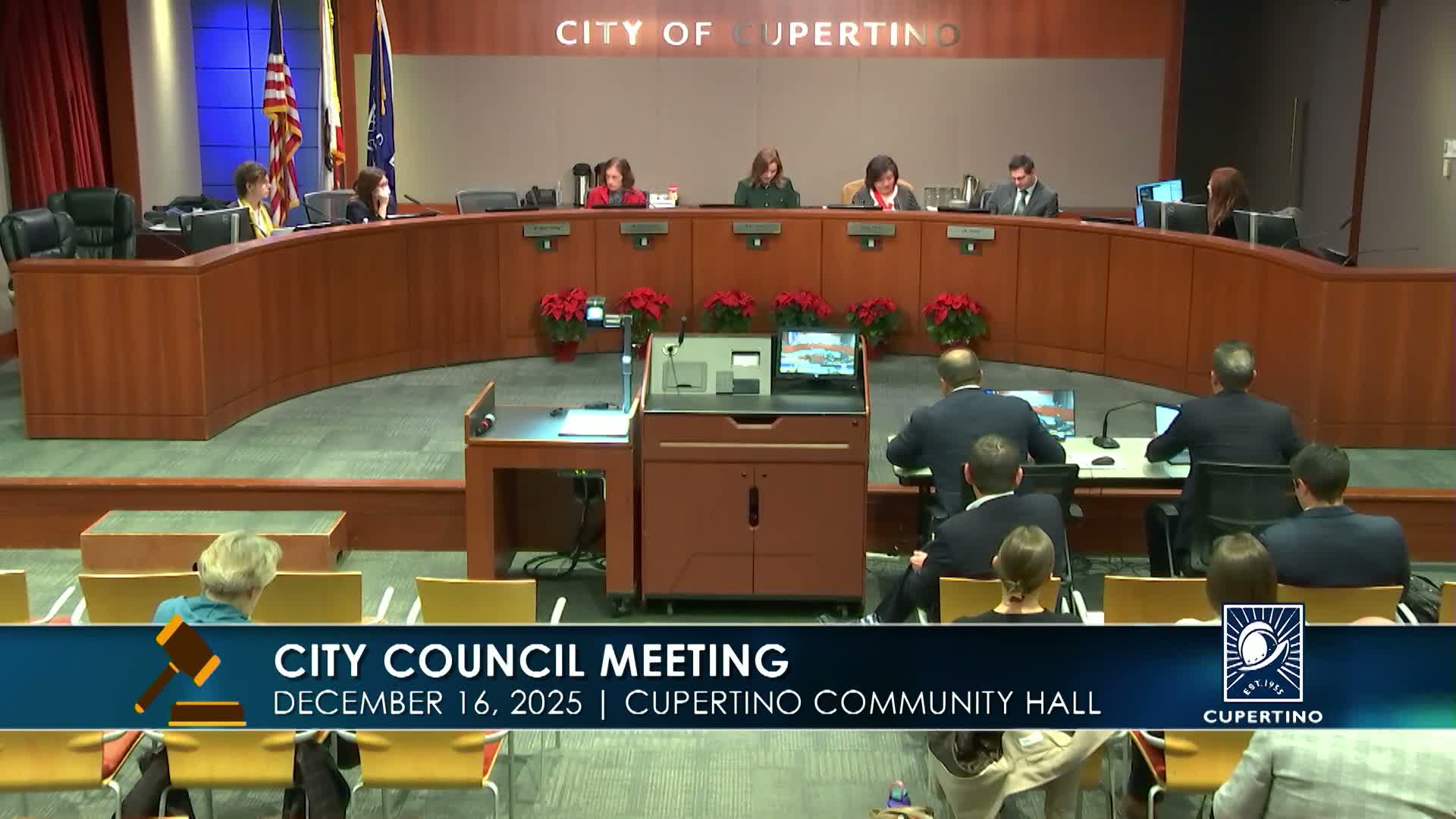
Summary
The City Council approved a 55‑unit townhome project (plus 10 ADUs and 11 below‑market units) at the former United Furniture site on Stevens Creek Boulevard. Council and consultants required DEH oversight, long‑term vapor mitigation and deed restrictions before ground‑disturbing permits. Opponents raised retail loss and public‑health concerns.
Cupertino — The City Council approved a residential project for the former United Furniture site on Stevens Creek Boulevard, voting unanimously to accept staff recommendations that condition approval on environmental oversight and monitoring.
The Toll Brothers plan calls for 55 townhome condominium units with 10 accessory dwelling units; 11 units will be designated as below‑market‑rate (six at the medium income level and five at moderate income). Senior Planner John Martier outlined the project and application history, saying the site is roughly 2.68 net acres and the proposal yields about 20.5 dwelling units per acre, below the 25‑du/acre baseline the applicant claims under state density bonus law. "Because it's more than five net new dwelling units and it has about 20% BMR units, it does qualify for density bonus," Martier said.
The council and members of the public spent more than two hours focused on site contamination and cleanup. PlaceWorks senior engineer Terry McCracken described ongoing remediation at the location, reporting that soil vapor extraction has reduced PCE concentrations on‑site "from about 30,000 micrograms per meter cubed now down to about 600 to 1,000 micrograms per meter cubed," and noting that the residential screening level cited by DEH is "15 micrograms per meter cubed." McCracken said the standard professional approach on sites like this is to install a vapor intrusion mitigation system (VIMS) and maintain it under deed restriction and long‑term monitoring: "Once they have this system in place... they have to undergo five years of operation and maintenance monitoring under the supervision of [Santa Clara County] Department of Environmental Health."
Staff and the applicant emphasized that no grading or building permits will be issued until the county environmental authority provides the required approvals. The council’s draft condition (Condition 7) specifies that ground‑disturbing work cannot proceed without DEH clearance. City counsel and staff discussed an apparent tension between an older municipal code provision calling for a "no further action" letter and state law allowing continued remediation and deed restrictions; the city attorney recommended updating the municipal code to align with state oversight practices while retaining oversight requirements in the permit condition.
Several residents urged caution. Jennifer Griffin and Rhoda Frey told the council they are concerned about the cumulative loss of retail along Stevens Creek and long‑term health effects linked to historical contamination in the region. Planning‑commission chair Sam Rao, speaking as a resident, said neighbors preferred the proposed low‑rise townhome option to higher‑density alternatives and noted that the seller has been conducting remediation prior to sale, which creates an economic incentive to complete required cleanup.
Applicant representative Nick Costa said Toll Brothers and the seller have worked with DEH on remediation and that the developer would not seek or secure building or grading permits until environmental approvals are in place. "We're not going to get a building permit, grading permit, final map until the DEH part has been resolved," Costa told council.
Council members balanced housing goals and environmental caution. Several members expressed concern about loss of retail, parking and spillover effects; others emphasized enabling housing and resolving long‑standing contamination. After public comment and extended technical testimony, the council voted to approve staff’s recommended actions, including use of the Class 32 CEQA infill exemption with the added Condition 7 requiring DEH oversight, VIMS as needed, deed restrictions and monitoring prior to or as part of occupancy approvals.
What happens next: the approval allows the applicant to continue toward final maps and building permits, subject to the environmental conditions and DEH sign‑offs. The staff packet and the council’s adopted resolutions list appeal and reconsideration procedures and note that the applicant may proceed to permit application once the oversight agency’s conditions are satisfied.
Authorities noted in the hearing include the Class 32 CEQA categorical exemption (infill development), references to AB 130 (statutory CEQA exemption processes and tribal consultation), and the Housing Accountability Act (referenced in discussion of state limits on additional environmental review for qualifying housing projects). Santa Clara County Department of Environmental Health is the oversight agency referenced for remediation sign‑off and long‑term monitoring.
Community context: residents emphasized the project’s location within the Stevens Creek Boulevard corridor and the local concern that multiple SB 130 projects could displace retail. Staff forecasted modest net fiscal benefits in some scenarios but noted tradeoffs among sales‑tax trends, property‑tax stability and retail loss.