
Board of Equalization denies Southern California Edison’s 2025 appeal, affirms $41.66 billion unitary value
Get AI-powered insights, summaries, and transcripts
Subscribe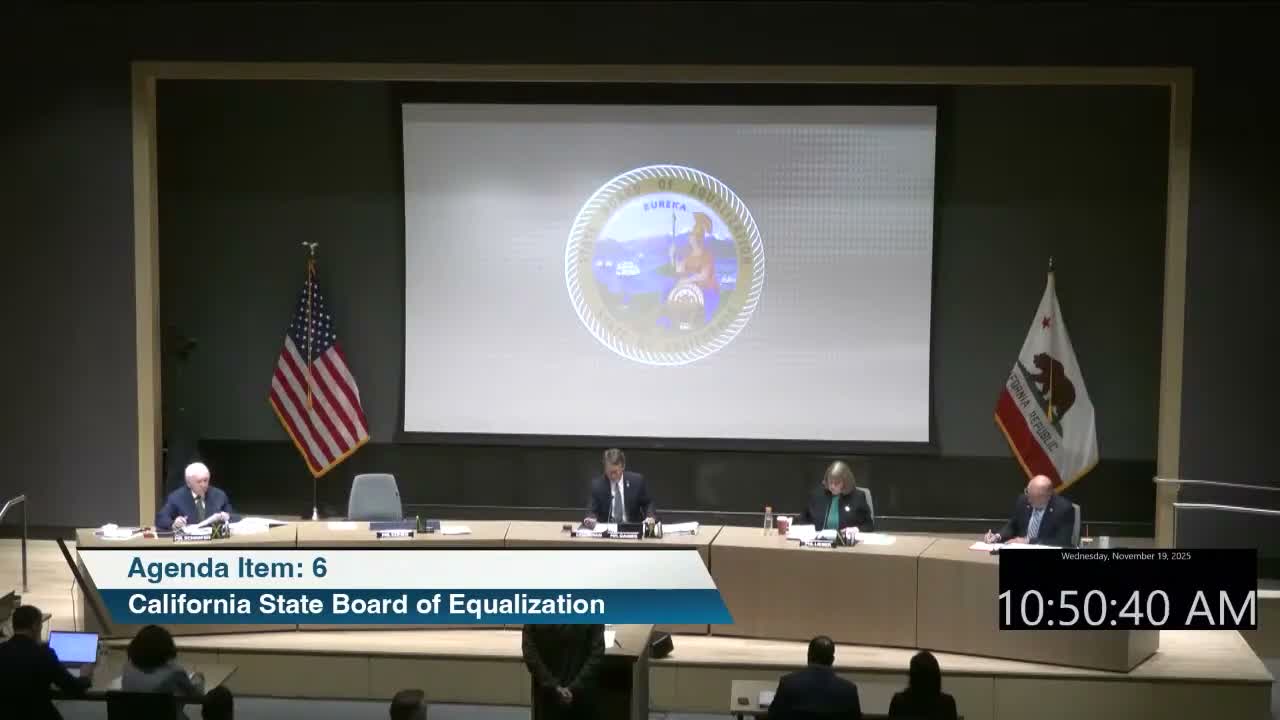
Summary
After a multi-hour oral hearing focused on wildfire-related costs and valuation methodology, the Board of Equalization voted to deny Southern California Edison’s petition and affirm the board-adopted 2025 unitary value of $41,664,500,000. Petitioner had sought $35,821,100,000, arguing wildfire mitigation costs and insurance treatment distorted historical-cost valuation.
The California State Board of Equalization denied Southern California Edison’s (SCE) 2025 petition for reduction of its board-adopted unitary value, affirming the $41,664,500,000 figure the board set for tax year 2025. The board voted 4–1 after hearing 60-minute opening presentations from counsel for Edison and the State Assessed Properties Division (SAPD) and extended questioning by board members.
Edison’s counsel, led by appeals attorney Lou Ambrose and private counsel Marty Decassian, asked the board to reduce the 2025 unitary value to $35,821,100,000. They argued that several wildfire-related items should be excluded or adjusted from the historical-cost-less-depreciation (HCLD) indicator: (1) capital expenditures mandated by AB 1054 that do not generate an allowed return; (2) the company’s $2,400,000,000 initial contribution to the wildfire insurance fund, which counsel said should be annualized or treated as an intangible; and (3) continuing liabilities arising from 2017–2018 wildfire claims. Counsel also argued that the longstanding 75/25 weighting of HCLD and the income (capitalized earning ability) indicator produces a large, unexplained divergence (roughly $8 billion or ~23% in recent figures) and that, under Rule 8 and appraisal best practice, the income approach should carry greater weight when indicators diverge.
SAPD representatives (David Luhan, Sonia Yim and Jack McCool) recommended denying the petition. Staff told the board petitioner had presented largely repetitive arguments over several years with limited new evidence and that staff had already accounted for wildfire risk through several adjustments, resulting in roughly $2.9 billion of wildfire-related reductions in the staff valuation. SAPD cited external signals — including credit-market commentary and CPUC findings — that mitigation steps and legislation (including AB 1054 and later measures) have materially reduced wildfire-related risk in the lien-date analysis. SAPD also defended the 75/25 indicator weighting as an appraisal decision based on methodology reliability and available data.
Board discussion focused on two central questions: which value indicator a willing buyer would rely on when indicators diverge, and whether wildfire-era adjustments (capital expenditures, prepaid insurance contributions, and claim liabilities) should be reflected differently in the HCLD or income approaches. Petitioner’s counsel argued a willing buyer would exclude non-income-producing mandated capital expenditures from HCLD and would treat the $2.4 billion insurance fund payment as an annualized expense or intangible that improves future cash flow; staff countered that mitigation and regulatory rate-making make HCLD still a reliable indicator in this sector and pointed to updated adjustments the division has applied.
Vice chair Lieber moved to deny the petition and affirm the board-adopted value; Member Vasquez seconded. Chairman Gaines voted No; Vice chair Lieber, Member Vasquez, Member Schaeffer and Controller Cohen voted Aye, and the motion passed. The appeals attorney will draft a written decision memorializing the board’s action under Revenue and Taxation Code §40.
The board’s decision leaves unchanged the 2025 unitary valuation for SCE while noting both sides urged additional data or methodological updates: Edison pressed for removal or exclusion of AB 1054–related capital expenditures and for annualizing the $2.4 billion insurance contribution; SAPD said petitioners have the burden of proof and that staff’s adjustments and reconciliation are appropriate given the evidence presented.
What’s next: under §40, the appeals attorney will prepare a written decision reflecting the board’s vote; the petitioner retains any further remedies available after administrative exhaustion.