Get Full Government Meeting Transcripts, Videos, & Alerts Forever!
Get email alerts on the Environmental Flows Project topic
No spam. Unsubscribe anytime.
State launches three‑year effort to make California Environmental Flows Framework usable statewide
Summary
The California Environmental Flows Work Group announced a three‑year, CDFW‑funded project to refine statewide models, build tools and an implementation dashboard, and expand outreach to help managers apply the California Environmental Flows Framework (CEF). The program runs through February 2028.
The California Environmental Flows Work Group on its quarterly call announced a three‑year project to translate the California Environmental Flows Framework (CEF) into practical tools for managers across the state.
Chris Taniguchi Kwan, co‑chair of the work group, said the project — funded by the California Department of Fish and Wildlife’s cannabis restoration program — is designed to "make CEF ... more usable, more actionable, and accessible for agencies and practitioners across California." The team plans to complete the work in about three years, with a wrap‑up in February 2028.
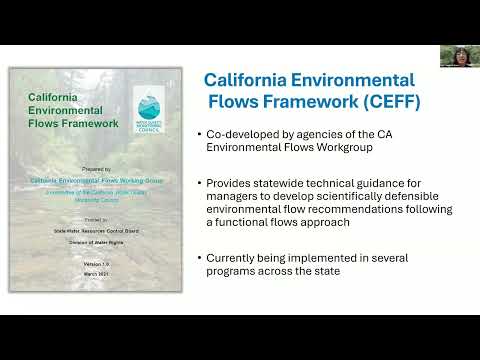
Why it matters: CEF provides statewide guidance to develop scientifically defensible ecological flow recommendations. Work group leaders said managers often struggle to move from guidance to on‑the‑ground actions; the new project aims to close that gap by producing models, a user‑focused dashboard, and outreach materials.
What the project will produce: presenters outlined four main components — (1) refinement of statewide unimpaired‑flow models and tools to predict ecological flow metrics; (2) technical tasks to assess groundwater‑pumping impacts and flow–water‑quality interactions; (3) an environmental flows dashboard to map where CEF has been implemented and to analyze gauge and ecological data where available; and (4) implementation guidance and workshops for practitioners.
Leads and partners named include UC Berkeley (Ted Grantham and Sarah Renal) on unimpaired flows, The Nature Conservancy and USGS on a separate technical task, and Southern California Coastal Water Research Project (SCORP) on water‑quality work. The team said it will coordinate case studies and offer workshops to facilitate adoption.
Next steps and outreach: speakers said they will post presentations and resources to the work group website and host workshops. Chris Taniguchi Kwan invited feedback from members and said the team is coordinating tribal outreach for watershed case studies.