Get Full Government Meeting Transcripts, Videos, & Alerts Forever!
Get email alerts on the Vocabulary Pcr Methods topic
No spam. Unsubscribe anytime.
User group adopts new guidance for species-specific PCR assays and method naming
Summary
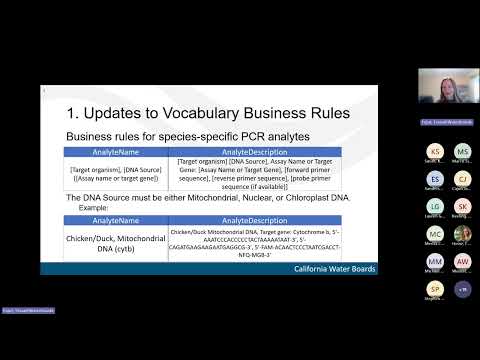
At the Council’s December user-group meeting, staff said they will add a vocabulary business rule to record species-specific PCR assay details (DNA source, target gene, primer/probe sequences) and standardize method names to include edition/year to align with ELAP and U.S. EPA guidance.
At the December user-group meeting of the California Water Quality Monitoring Council, database manager Tessa Foggitt said staff will add new vocabulary business rules to capture species-specific PCR assay details and to standardize how laboratory methods are named.
"It specifies the DNA source, which would either be mitochondrial, nuclear, or chloroplast," Foggitt said, adding that descriptions will include the forward and reverse primer sequences and probe sequence when available. She gave cytochrome b as an example of a target gene used in a species-specific assay.
The new rule aims to distinguish assays that sample an organism directly (species-specific assays) from microbial source-tracking PCR that uses a water sample to detect genetic markers. Foggitt said PCR analytes will remain in the chemistry tables because PCR typically reports concentrations such as gene copies per milliliter, whereas meta-barcoding eDNA that produces community taxonomy will be managed in taxonomy tables.
Foggitt also described a separate change to how standardized methods are recorded. "For standard methods, it's always gonna have a year that the method was updated as part of the name," she said, noting the change is intended to align names and descriptions with Environmental Laboratory Accreditation Program (ELAP) certificates and U.S. EPA guidance.
Existing methods in the current database will not be retroactively changed immediately; the team plans to normalize the method names as part of the SEEDin2 transition. New method requests already will be recorded using the updated naming conventions, which may include edition or reapproval years when applicable.
The change is intended to make it easier for data users to match assays and methods exactly across datasets and reduce ambiguity when multiple versions of a method exist. Foggitt said staff will verify how ASTM reapproval dates should appear and follow up with the group.