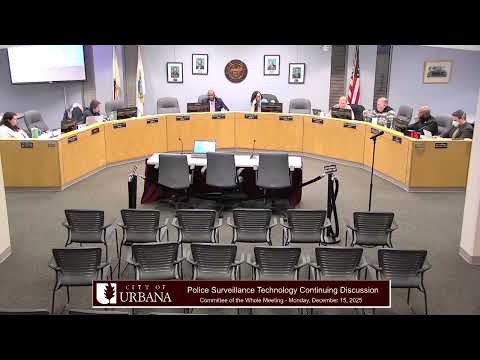
Urbana committee continues surveillance-technology ordinance talks; seeks staff presentation and council preferences
Loading...
Summary
The Committee of the Whole further discussed ordinance 2024-12-042 on police surveillance technology, focusing on definitions (including 'surveillance' and 'exigent circumstances'), scope (police-only vs citywide), oversight by CPRB/HRC, and the use of location products such as Placer AI; staff will present more in January and the clerk will solicit council preferences by Dec. 22.
The Committee of the Whole continued deliberations on the proposed police surveillance-technology ordinance (ordinance 2024-12-042) but took no final vote. Council members and staff identified a small set of remaining issues—definitions, the ordinance’s applicability (police department only versus all city departments), oversight and complaint-handling (Civilian Police Review Board vs. Human Rights Commission), the definition of exigent circumstances, and the classification of third-party location/data products such as Placer AI.
Council member Grace summarized the committee’s recent work on draft 7.2 and identified three main outstanding items: finalizing definitions, deciding whether the ordinance should apply across departments or only to police, and clarifying oversight mechanisms in section 8. Mary Alice and others raised questions about the definition of “exigent circumstances,” with specific concern that terms such as 'disaster' be used carefully so that short-term public-safety uses are not unintentionally excluded.
Grace told the committee the draft references the Illinois Emergency Management Act to set a high bar for exigent circumstances, and that the intent was to let the mayor or the mayor’s designee determine whether an occurrence met that statutory definition without requiring a formal gubernatorial or mayoral emergency declaration. James asked for clarity on practical thresholds (for example whether a single-person threat would qualify) and suggested the committee hear from the mayor about how much discretion would be appropriate.
Council members also debated oversight language in section 8 and whether the Civilian Police Review Board (CPRB) should be required ("shall") to review reports or only permitted ("may") to do so, and whether the CPRB or the Human Rights Commission (HRC) is the appropriate oversight body depending on whether the ordinance is police-specific or citywide. Carla explained the current HRC complaint/appeal flow and the CPRB’s receipt of complaints; committee members asked staff and legal counsel to clarify how those boards would participate under different scope options.
Members asked for more information about products such as Placer AI. Darius, speaking for staff, said Placer AI can provide footfall and movement analytics and demographic aggregates and does not provide personal identifiers such as names, phone numbers or home addresses; he offered to give a fuller presentation in January. Grace and Mary Alice said publicly available descriptions of movement-data products can include connected-route information and asked staff to explain re-identification risks and how the proposed ordinance would treat such products.
To give staff a clear direction for their January work, the chair and clerk proposed collecting a quick, written preference from each council member indicating whether they favor applying the ordinance to the police department only or to all departments; the clerk will email members and requested responses as soon as possible with a suggested cutoff of Dec. 22 so staff can prepare for the January meeting. The committee agreed that such a written preference would be a nonbinding staff direction (a straw poll), not a final council action.
No formal vote on ordinance language occurred at this meeting. Staff will prepare additional materials and a presentation for the council in January so the committee can resolve the remaining definition, scope and oversight questions.