Urbana committee advances FEMA firefighter grant amendment amid legal and values debate
Loading...
Summary
The Urbana Committee of the Whole voted 3–2 to send a budget amendment to accept FEMA’s Assistance to Firefighters Grant for radios to the regular council agenda after a debate over immigration-cooperation and equity-related grant language and legal updates that city staff said largely remove those clauses for this grant.
Urbana’s Committee of the Whole voted to send an ordinance revising the city’s annual budget to accept a FEMA Assistance to Firefighters Grant (AFG) for radios to the full City Council for final approval, after an extended discussion about legal language in federal grant agreements.
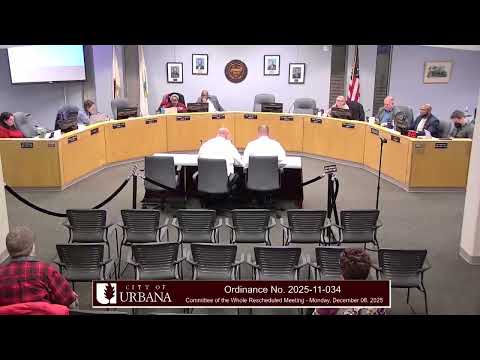
The item — ordinance 2025-11-034, budget amendment #3b — would allow the city to buy radios for the fire department using federal grant funds; staff said the radios have not yet been purchased and would be procured from a state bid list to speed delivery and reimbursement.
City Attorney Matt said recent litigation and agency changes have altered how immigration-cooperation conditions in federal grants apply. "While the actual, substance of the case was pending in front of the court, which it still is, the injunctive order is still in effect," he said, and noted FEMA has inserted language in its agreements stating the immigration provisions do not apply to this grant (Article 58). He added that the order has been appealed but that, "it's explicit in article 58 of the grant agreement" that the immigration provisions do not apply to this award.
Several council members said they remained concerned the grant language references equity-related provisions and a vaguely defined "discriminatory prohibited boycott," and worried about reputational or practical consequences if the city accepts or later rejects federal funds. Council member Grace said, "This is not about the radios... It's about the agreement with Homeland Security," and asked for continued scrutiny of similar language across other federal grants.
Fire Department staff framed the vote as a practical step to obtain equipment: "Our true goal in this whole process... is always to bring alternative funding and help support the city, help support the fire department," the Fire Chief said when introducing the item. Staff also confirmed that, once ordered from the state bid, radios could be purchased immediately and that reimbursement timing from the federal government has varied; finance staff estimated up to about 90 days in some cases but noted it can be much faster.
Council members also discussed whether declining a grant could mark the city a "poor performer" and affect future awards. Counsel said FEMA guidance and historical practice show applicants who decline awards during negotiation are not formally penalized, but peer-review perceptions and how an applicant is scored could be affected in future funding rounds.
Council member Mary Alice moved to send the ordinance to the regular City Council agenda; the motion was seconded and passed by a committee voice vote, 3–2. Because this was action in the Committee of the Whole, the final vote on accepting the grant will occur at the City Council meeting where the ordinance appears on the regular agenda.
Next steps: the ordinance will appear on the regular council agenda for a final vote; staff said they will supply the written legal memo and court citations requested by council members before that meeting.