Get Full Government Meeting Transcripts, Videos, & Alerts Forever!
Get email alerts on the Zoning Variance topic
No spam. Unsubscribe anytime.
Applicant asks board to allow used-car sales at 2019 Oxford State Road; staff flags missing zoning certificate
Summary
Dylan Mohammed told the board he bought 2019 Oxford State Road and holds a state dealer license; city staff reported no certificate of zoning compliance or occupancy for automotive sales, outlined code criteria, and recommended conditions if the board approves. No final vote is recorded in the transcript.
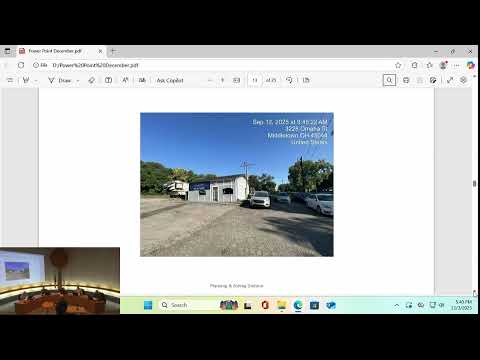
Dylan Mohammed asked the board to allow automotive sales at 2019 Oxford State Road, telling the panel the property had been operating as a used-car lot before he bought it and that he holds a state dealer’s license. City staff told the board it has no record of a certificate of zoning compliance or a certificate of occupancy for automotive sales at the site and said a notice of violation was sent to the prior owner in February 2024.
The variance request is to permit automotive sales and leasing on land zoned R‑4, a district that staff said does not permit that use under Middletown’s development code. Staff’s presentation reviewed the BZA’s variance criteria and said the proposed use is not a permitted R‑4 use; staff additionally summarized use‑specific standards for automotive sales that would typically apply, including minimum lot size (4 acres), minimum frontage (200 feet), requirements for screening of outdoor display and storage, arterial‑street location, hours and loudspeaker limits adjacent to residential districts, display of the dealer’s license, and the requirement of a permanent principal structure.
John Roach, city counsel, told the board that a nonconforming use that ceases for 12 consecutive months cannot be reestablished without a variance, but that a granted use variance “runs with the land.” Roach also noted the BZA can add conditions to an approval but urged consideration of enforcement practicality.
Mohammed said he bought the parcel after seeing it listed as commercial on public records and that he believed the tenant holding a dealer’s license had been operating the lot for at least a year before he bought it. “The state issued my license, and we’ve been operating with no issues,” Mohammed said, adding he contacted city staff immediately after receiving the notice and that he is willing to comply with whatever the board requires. He told the board his current hours are Wednesday–Saturday, 10 a.m. to 6 p.m., and that the lot currently holds about 10–12 vehicles and can fit roughly 20.
Board members and staff discussed specific conditions they could attach to an approval to limit impacts: screening of display and storage, a requirement that the lot not extend behind the commercial building or to the rear house on the parcel, a ban on on‑site mechanical work, limits on hours or number of cars, and restrictions on outdoor loudspeakers next to residential properties. Staff emphasized that some conditions (for example, hours of operation) may be difficult to enforce and noted that because the lot is smaller than the code’s 4‑acre minimum the applicant may also need a conditional‑use application to the planning commission for certain relief.
A board member moved to approve under the board’s existing commercial allowance language and another member seconded, but the transcript does not record a roll‑call vote or a final outcome in the provided segments.
Next steps, as discussed on the record: if the BZA approves a use variance it can attach conditions similar to those summarized by staff; if the lot cannot meet the code’s lot‑size standard the applicant may also need to pursue a conditional‑use review before the planning commission.