Get Full Government Meeting Transcripts, Videos, & Alerts Forever!
Get email alerts on the Project Vector topic
No spam. Unsubscribe anytime.
DeKalb planning panel backs 560‑acre "Project Vector" data‑center annexation, forwards recommendation to council
Summary
The DeKalb Planning & Zoning Commission voted Dec. 1 to recommend annexation, rezoning to PDI and approval of development plans for Project Vector, a multi‑phase data‑center campus proposed across about 560 acres that would build four data‑center buildings and two electrical substations; commissioners included an added conservation‑area condition and requested follow‑up on technical questions.
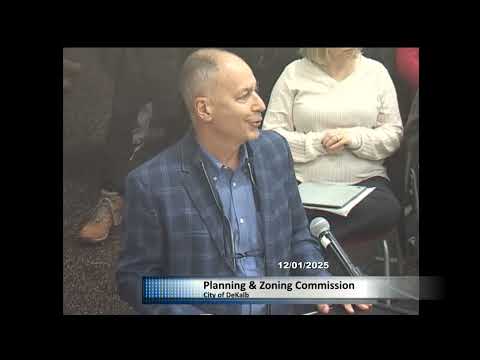
Jerry Krasinski, representing Chicago West Business Center, asked the DeKalb Planning & Zoning Commission on Dec. 1 to approve annexation, rezoning to PDI and a final plat for roughly 560 acres the applicant calls Project Vector, a multi‑phase data center campus with four buildings and two electrical substations.
Krasinski said the proposal follows DeKalb’s 2005 and 2022 comprehensive plans and the site’s inclusion in an expanded enterprise zone. He told commissioners the total campus would be “just under 3,000,000 square feet” across the 560‑acre site, built in four phases over an estimated six to eight years. The application packet and staff report listed approximate building sizes (staff cited about 980,000 sq ft for Building 1, 550,000 sq ft for Building 2, and ~490,000 sq ft for Building 4) and noted Building 1 could be completed as early as the fourth quarter of 2027; Building 4 was estimated around 2032.
The applicant and operator (Endeavor/Edge) described technical and environmental measures they say distinguish Project Vector from other facilities: a closed‑loop, water‑charged cooling system they described as "waterless" in regular operation (using food‑quality propylene glycol in a sealed loop), low‑emission on‑site generators branded as "TurboCell," rooftop sound parapets and 22‑foot acoustical barriers around mechanical equipment, and a stormwater design that the engineering team said meets or exceeds DeKalb’s stormwater ordinance. Acoustical engineer William Bone said modeling using manufacturer data and industry software shows the project would meet DeKalb noise limits and Illinois Pollution Control Board frequency‑band criteria with the proposed mitigation.
Speakers for and against the project appeared in large numbers. Supporters (including labor representatives and the DeKalb County Economic Development Corporation’s executive director, Melissa Medio) emphasized construction jobs, union employment and increased tax revenue for local taxing bodies. Opponents — including adjacent residents and environmental advocates — raised concerns about visible impacts, round‑the‑clock noise, long‑term energy and greenhouse‑gas effects from fossil‑fuel generation, potential displacement of agricultural land and whether communities that remain unincorporated would receive benefits while residents bear the impacts.
Commissioners pressed for more detail on energy use, how utility upgrade costs will be allocated, and long‑term commitments should the applicant later seek to change cooling systems or water use. City staff and the applicant said the annexation and planned‑development standards incorporate review steps for future phases; a change that would materially affect water or other utilities would require an amendment to the annexation/development agreement and a public hearing before council.
After wide public comment and technical answers from the applicant (including a description of TurboCell hydrogen compatibility and an outline of methane‑pyrolysis as a potential hydrogen supply path), Commissioner McMahon moved, and the commission seconded, a motion to forward the required findings of fact and recommend approval of the annexation, rezoning to PDI, development plan, building elevations and final plat for the Project Vector site, including an added conservation‑area paragraph requested by an adjacent property owner. The motion passed on a roll‑call vote.
Next steps: the commission’s recommendation will go to the City Council for final action. Staff and the applicant said further engineering submittals and phased final plats will be reviewed at staff level and would return to the council for certain changes; an amendment to the annexation agreement would require council approval and public notice.
Details to note: the applicant anticipates about 100 full‑time operations employees for the first building (with similar scaling for later buildings), two substations on site, and a phased timeline that could extend into the early 2030s. Letters of support in the record included several local taxing districts and Northern Illinois University. The Illinois Department of Agriculture provided a letter in April 2024 indicating the enterprise‑zone expansion was consistent with farmland‑preservation policy.