Get Full Government Meeting Transcripts, Videos, & Alerts Forever!
Get email alerts on the Land Use topic
No spam. Unsubscribe anytime.
Pleasanton planning commission hears public comment on Hidden Canyon draft EIR; staff flags VMT as significant and unavoidable
Summary
On Dec. 10 the Pleasanton Planning Commission held a study session on the draft EIR for the Hidden Canyon Residences & Preserve project, a 28-home development with 104.6 acres of proposed open-space dedication. Staff said the DEIR identifies a significant and unavoidable vehicle-miles-traveled (VMT) impact; commissioners recommended extending the public comment period to 60 days.
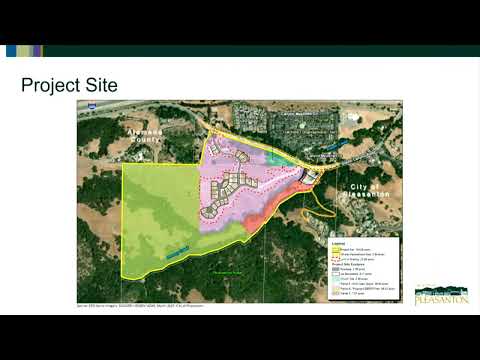
Pleasanton — The Planning Commission on Dec. 10 heard a staff presentation and public comment on the draft environmental impact report (DEIR) for the Hidden Canyon Residences and Preserve project, a Ponderosa Homes proposal that would build 28 single‑family homes on 23.89 acres of a 130.98‑acre site while dedicating 104.6 acres as open space.
City staff told the commission the DEIR analyzed 16 environmental resource areas and identified one significant and unavoidable impact: transportation. "The EIR did discover 1 significant and unavoidable impact, and that is in the area of transportation," the staff presenter said, citing vehicle‑miles‑traveled (VMT) thresholds under CEQA guidance. Staff noted the city has not adopted local VMT thresholds and said the finding is consistent with an earlier housing element EIR.
The project description in the draft EIR includes annexation and rezoning of portions of the site, a development plan and tentative map, demolition and rebuilding of two existing residences, a new trailhead and trail connections to the East Bay Regional Park District, roadway widening on Dublin Canyon Road, and a new traffic signal at the Canyon Meadows intersection. Staff said the public review period for the DEIR was scheduled to end Jan. 5, 2026, and that all written and oral comments received will be included and addressed in the final EIR and associated mitigation monitoring and reporting program.
Public commenters split between concerns about visual and environmental impacts and support for the proposed roadway safety work. Janet Gardner, president of the Canyon Meadows homeowners association, said the traffic signal and pedestrian improvements were central to her support: "This is a crucial piece of the Ponderosa proposal without which I would have a hard time lending support," she said.
Neighbor Andrew Gelb challenged the DEIR's visual analysis and urged stronger mitigation for grading and views, saying the document's conclusion on scenic impacts lacked credibility. "This is desecration," Gelb said, arguing for fewer homes, single‑story designs, terraced and planted retaining walls, and mature screening trees.
Other commenters raised access and property rights issues. Local landowner Robert Devaney told the commission a historic ranch access road and associated agricultural uses cross the site and said those uses were not adequately discussed in the DEIR, calling it "a deficiency" that should be addressed before project approval.
The applicant and project team said the design balances development and preservation. Applicant representative Jeff Schrader said the project has been under review for several years, that the plan had been reduced to 28 lots to conform with Measures PP and QQ, and that the project includes mitigation land. A member of the project team described a cash donation to capital improvements on Dublin Canyon Road: "So we're actually making a cash ... half $1,000,000 donation to the city for its traffic improvement," the project representative said, and the team emphasized planned stormwater basins and onsite treatment to avoid increasing peak runoff.
On process and schedule, staff said the DEIR is a study‑period document and no project entitlements were being decided that night. Commissioners and staff agreed to return the final EIR and the entitlements package to the commission in spring 2026 (staff tentatively mentioned March) for public hearings and full project review.
Because the holiday season overlaps the posted review period, the commission recommended extending the DEIR comment period from 45 days to 60 days and asked staff to issue a follow‑up notice under CEQA procedures. Staff said they would notify the State Clearinghouse and affected agencies as part of the statement of completion and the notice of availability process.
What remains: the record‑making period for final comments will close after the extended review window, staff will prepare responses to comments and an updated mitigation monitoring program in the final EIR, and the commission expects to see the full entitlement package in early 2026. Staff advised residents with detailed technical questions to contact project planner Derek Farmer for exhibits and site plans.
The commission closed the public hearing, recessed briefly and then resumed to discuss commissioner questions and next steps before adjourning the meeting.