Get Full Government Meeting Transcripts, Videos, & Alerts Forever!
Get email alerts on the Disaster Recovery topic
No spam. Unsubscribe anytime.
Pasco County details $585 million HUD recovery package and launches $205 million individual housing program
Summary
Pasco County officials told Port Richey residents that HUD approved a $585 million recovery allocation; the county has launched a $205 million individual housing program with priority for the most vulnerable households and strict HUD AMI rules that limit how funds can be spent.
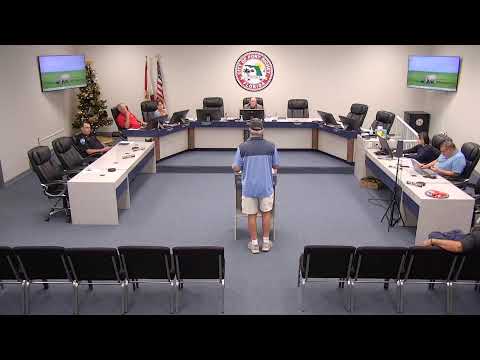
Pasco County has received $585,000,000 in federal disaster-recovery funds and launched an individual housing program intended to help homeowners repair, rebuild or relocate after recent hurricanes, county recovery director Chuck Lane told a Port Richey town-hall audience.
Lane said the HUD-approved plan dedicates roughly $205,000,000 to the individual housing track and allocates other funds to infrastructure, mitigation and a $10,000,000 public-services pot. "Pasco County received $585,000,000 from the federal government," Lane said, and the county is now moving from planning to execution.
The program includes reimbursements for out-of-pocket storm-related expenses, repair and reconstruction grants, elevation funding when required by code, voluntary buyouts and temporary relocation payments. Lane described federal constraints that shape the program: "70% of the funds have to be spent on households that earn 80% of the area's median income or less," and the county can only use a limited portion to assist households up to 120% of area median income without risking a federal clawback.
Lane said phase 1 will prioritize very-low-income households and those meeting any of four vulnerability criteria: households at or below 50% of AMI; a child age 5 or younger in the home; a senior age 62 or older; a disabled household member; or households still displaced by the storms. Manufactured and mobile homes are handled separately under tighter limits; currently assistance for manufactured housing is focused on displaced households that also include either a senior or a child in the household.
County officials provided award caps for commonly requested repairs and projects: a typical repair cap of $175,000 for traditionally built homes, a rebuild cap of $330,000 and up to an additional $100,000 where elevation is required by code. For manufactured homes Lane cited smaller caps (repair roughly $30,000; replacement estimates provided by Lane were about $145,000 for a single-wide and $225,000 for double/triple-wide units). Lane characterized these figures as program maxima and said the county will update guidance as it implements the program.
Applications will require documentation and HUD verification; the county will assign each applicant a case manager and hold countywide intake events (8 a.m. to 8 p.m., with two-hour appointment slots and walk-in capacity). Lane emphasized federal "duplication of benefits" rules: if an eligible repair costs $100,000 and an applicant already received $40,000 from FEMA, the county may provide up to $60,000. He said applicants should expect rigorous review of other assistance, but that documented out-of-pocket expenses (hotel stays, contractor payments, equipment expenses) can be considered.
Lane described timing estimates for approvals that vary by case: some straightforward approvals may be completed in one to two weeks; others that require environmental review can take longer. He encouraged coordination between the city and county to identify substantially damaged households and urged residents to use available technical assistance if they struggle with the application.
City officials asked the county to provide media materials to support local outreach; Lane said county staff can provide content and suggested that cities use utility bill inserts, newsletters and targeted phone calls to reach residents who may not be online. The county also said it will maintain HUD-required program pages and active phone and email contacts for applicants.
The county presented program-scale estimates as an early projection, not final counts: Lane said the county expects to repair roughly 800 homes (including manufactured homes), replace about 250 manufactured homes and reimburse roughly 500 homeowners, calling those numbers "an educated guess."