San Jose DOT recommends restoring Westgate Mall lane, altering bollards after year‑one Saratoga evaluation
Summary
City transportation officials recommended reinstalling a third northbound lane on Saratoga Avenue at Westgate Mall, replacing some intersection bollards with 100‑foot merge areas, and running a year‑2 evaluation and speed‑camera program after mixed year‑one safety results and community feedback.
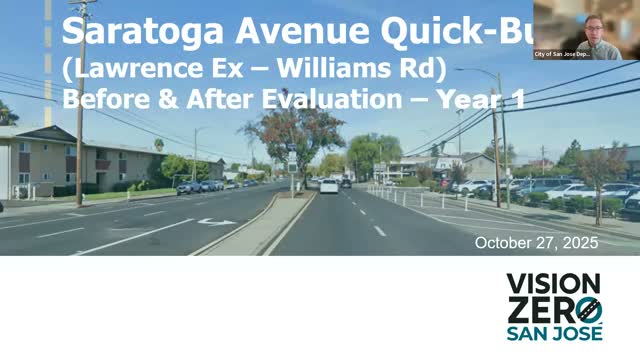
San Jose transportation officials on Tuesday presented a year‑one evaluation of the Saratoga Avenue quick‑build safety corridor and recommended bringing back a third northbound lane along the Westgate Mall frontage while replacing some protected‑lane bollards at intersections with merge areas, pending meeting approval.
The recommendation came as Jim Bittner, acting division manager for the Vision Zero and traffic safety team at the Department of Transportation, said the quick‑build installations were intended to reduce severe crashes and improve conditions for pedestrians and bicyclists. “We are aiming to eliminate traffic fatalities and severe injuries,” Bittner said during the virtual presentation.
DOT reviewed five years of pre‑installation data (2018–2023) and compared it with year‑one post‑installation results (2024–2025). Officials reported that while fatal and severe‑injury crashes did not increase, minor‑injury and overall crashes rose in the first year and were concentrated in a hotspot north of Westgate Mall between Campbell/Prospect and Atherton. Speed data showed small decreases in the sections where lanes were reduced: a 3‑mile‑per‑hour drop on Williams to San Tomas Aquino and a 1‑mph drop on the Country Club to Campbell section, DOT said.
To address the hotspot and access issues near the mall, DOT proposed restoring a third northbound lane on the mall frontage (Prospect/Campbell to Atherton) and placing pylons so right‑turn pockets remain usable. Bittner said the restoration would preserve circulation to 280 and mall access while still allowing bike improvements: “If this is something that is preferred, then we really wanna make sure it's installed as feasible as possible before the holiday season,” he said. DOT estimated repaving/striping work for the mall frontage at about $50,000.
On intersection approaches, DOT recommended removing some protected‑lane bollards and installing a roughly 100‑foot dashed merge area to reduce so‑called right‑hook conflicts where drivers turn sharply across bike lanes. Officials framed the change as an iterative quick‑build adjustment that can be revised after a year‑two evaluation following modifications. DOT also said it plans to install speed cameras along the corridor late next year.
Public reaction at the virtual meeting was mixed. Cyclists including Seth Farbury of West San Jose thanked DOT, saying, “I feel a lot safer thanks to the bike lanes.” Other residents pushed back, reporting longer commute times and more aggressive driving in areas where lanes were reduced. Don Eberhard, a frequent commenter, argued the problems were citywide and urged broader consistency in treatments: “This is widespread throughout the whole city of San Jose,” he said.
DOT responded to multiple technical and policy questions during the Q&A. Officials said the city designated Saratoga as a safety corridor under a recent state assembly bill that gives cities flexibility on posted speeds; council adopted a 35‑mph limit in August. DOT emphasized quick‑build tradeoffs: pylons are less expensive and quicker to deploy but require maintenance, while permanent concrete curb protections are costlier and typically require grant funding.
Cost and feasibility concerns also surfaced. DOT estimated roughly $400,000 per corner to remove triangular slip lanes and relocate signal equipment to create standard right‑turn geometry, and said protected intersections can cost on the order of $1.5–$2.0 million per intersection where grants are available.
DOT described the year‑one assessment as an initial diagnostic to identify hotspots and said a year‑two study after implementation of changes will provide stronger trend data. officials also said they will post the corridor's operational analysis and materials online and work with council offices to make datasets available for public review.
Council member Kamei closed the meeting by thanking participants, saying DOT will move forward with iterative changes and a year‑two review, and noting the presentation and Q&A will be posted on her website. No formal vote or city council action was recorded during the virtual presentation; the recommendations were presented by DOT for feedback and for consideration in subsequent implementation steps.
The DOT indicated implementation timing ranging from a short‑term restriping for the Westgate frontage (targeted before the Thanksgiving holiday if approved) to early‑2026 installation of intersection merge areas and late‑next‑year deployment of speed cameras. DOT urged continued community participation as it adjusts treatments based on year‑two findings and ongoing monitoring.