Lifetime Citizen Portal Access — AI Briefings, Alerts & Unlimited Follows
Planning commission tables Vanguard Renewables’ conditional-use application for anaerobic digester; staff requests safety documentation
Loading...
Summary
The Planning Commission heard a multi-hour public hearing on a proposed anaerobic digestion facility (Vanguard Renewables/‘Middletown AD1’) and, after extensive technical Q&A and public comment, voted to table the conditional-use application until the applicant supplies the city-required noxious-matter list and documented safety/response precautions and clarifies setbacks/height.
The Middletown Planning Commission on Nov. 12 heard a lengthy public hearing on a conditional-use application for a proposed anaerobic digestion facility on a ~28–29 acre parcel in Maid Industrial Park. The project, presented by Vanguard Renewables and an applicant entity identified in the packet as “Middletown AD1” (property owner John Westheimer), would process food and dairy waste in enclosed digesters to produce pipeline-quality renewable natural gas, liquid fertilizer and solids for bedding.
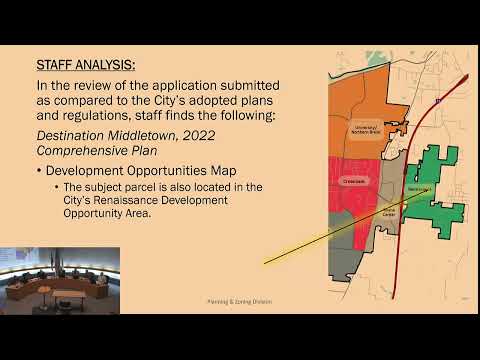
Planning staff opened the item by noting the site lies in the I-2 General Industrial District and that a gas transmission pipeline and a hazardous liquid pipeline cross the parcel. Staff confirmed the use is classified under the code as manufacturing/production with caustic or hazardous materials and said that, per the city’s conditional-use standards, the applicant must supply “a list of noxious matter or chemicals used during the manufacturing process and document the safety precautions that will be used to prevent potentially hazardous chemical reactions or contamination.” Staff told the commission that those documents were not included in the application packet.
Applicant representatives described the operation as fully enclosed and subject to Ohio EPA and other regulatory permits. “Our operations [are] completely indoor,” Majid McClouf, legal counsel to the applicant, said, and Vanguard’s Steve Oliveri described multiple layers of odor control and enclosure, backup power for critical systems and a process to upgrade biogas for injection into the on-site Enbridge pipeline. The project team also provided an engineering overview (Stantec) showing organics receiving areas, enclosed depackaging docks, gas upgrading equipment near the Enbridge metering station, and digestate storage tanks south of the pipeline.
Commissioners, staff and several departments pressed the applicant on several items that remain unresolved in the submission: submitted setbacks for hazardous-activity structures fall short of the code’s 600-foot residential setback in some locations (proposed setbacks ranged from approximately 100 to 280 feet on some property lines), the city has not yet received the required written list of hazardous/noxious materials (the applicant named ferric chloride and an antifoam but did not list produced biogas components in the noxious-matter list), and staff asked for documentation of safety measures and emergency response planning prior to formal action.
Nearby residents and technical experts raised concerns at the hearing. Laura Smiley, a bordering property owner and equine veterinarian, said she supports the project’s environmental aims but asked about runoff into Dicks Creek, possible disturbance to a nearby nesting great horned owl pair, and construction impacts. Process engineer Matt Thorpe raised technical safety questions about odor-control continuity during power outages, whether digestate tanks are tied to odor-control systems, the need for secondary containment for large digestate tanks, and potential effects on property values and nearby Monroe residences.
Applicant witnesses answered multiple technical questions on record: Vanguard said critical systems (including odor control) are on backup generators; digesters and tanks will be covered and subject to Ohio EPA permitting and air-treatment requirements; onsite stormwater will be handled with wet ponds and treated prior to discharge; and the company performs hazard analyses (HAZOP) and develops site-specific emergency response plans and over 70 critical safety controls. Vanguard said it expects to begin construction around April 2027, complete construction about a year later and begin full operations after about six months of commissioning. The company estimated a roughly $60 million capital investment, 50–100 construction jobs and 8–15 permanent jobs.
Despite the technical responses, staff and several commissioners said the missing written materials required by code must be part of the application before a final vote. Planning staff recommended the commission require submission of the noxious-matter list (including expected compositions of biogas), documented safety precautions, and clarification of any requested waivers (setback or height) prior to action. Commissioners moved to table the application to allow the applicant time to provide the required materials and clarify the digesters’ potential height and any needed variances. The motion to table passed unanimously on roll call.
Next steps: the application is tabled. Staff and the applicant will work to provide the written noxious-matter list, site-specific safety and emergency-response documentation, and precise engineering details (tank heights, setbacks) for re-submission and further review. Ohio EPA permitting and a finalized interconnection agreement with Enbridge were described as separate regulatory steps the applicant must pursue before construction.