Get Full Government Meeting Transcripts, Videos, & Alerts Forever!
Get email alerts on the Energy Storage Setbacks topic
No spam. Unsubscribe anytime.
Mesa council wrestles with 1,000‑foot battery‑storage separation amid industry warnings
Summary
Councilmembers debated a zoning text amendment that would permit battery energy storage systems under a new category but set a separation from residences (staff offered 400 or 1,000 feet). Supporters cited safety and precaution; opponents and SRP warned the larger distance could constrain clean‑energy capacity and economic development. The ordinance is scheduled for a Dec. 8 vote.
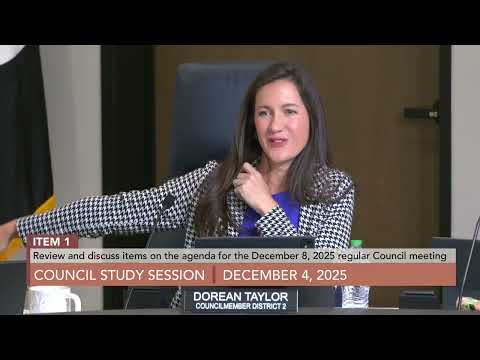
Mesa — Mesa councilmembers spent a large portion of Thursday’s study session debating a proposed ordinance that would allow commercial battery energy storage systems under city zoning but would require a minimum separation from residential property. The staff recommendation presented the council with two options — a 400‑foot separation and a 1,000‑foot separation — and councilors sharply divided over which should be the city’s floor.
Councilmember Jen Duff said she would vote against a 1,000‑foot requirement, calling it excessive and out of step with peer cities. “I have no idea how it got there,” Duff said of the 1,000‑foot figure and cited a survey of other cities that showed typical separation distances in the 100–500‑foot range. Duff warned that imposing a 1,000‑foot rule could make Mesa an outlier, reduce available sites for large‑scale battery projects and “limit our economic growth and grid reliability.”
Planning staff and other council members said the larger separation was proposed after residents and stakeholders raised concerns during outreach. “Staff changed our recommendation from 400 to 1,000 feet based on some of the feedback we were receiving,” a planning official told the council, adding that the range of separation policies nationwide varies widely and that there is no single technical benchmark.
SRP and industry representatives have cautioned the council that more restrictive separation rules can reduce available capacity and complicate energy planning. Council members also discussed that the draft ordinance contains a procedural clause that would allow two pending sites to be treated as legally conforming under the new text — an element staff said would only apply to the specific pending applications and would not automatically apply to future proposals.
The council repeatedly stressed that the ordinance could be amended later: staff noted that if the city approved 1,000 feet, council could return later with a code amendment to lower the distance, but doing so would require repeating the public hearings and planning process. City attorneys also cautioned the council that adopting a standard now could create legal nonconforming or procedurally conforming outcomes for projects already in the pipeline.
What happens next: The item was listed on the council’s Monday agenda for final action. Staff agreed to provide a map showing industrial zoning, the locations of substations and the specific sites that would be affected by each setback option so council members could better visualize the ordinance’s geographic impact.
Key details and numbers: staff offered two separation options (400 feet or 1,000 feet); city staff said separation standards nationally range from roughly 100 feet to as much as a mile in isolated jurisdictions; SRP warned the more restrictive option could eliminate capacity in planned projects. The ordinance includes a provision that would allow two pending sites to be treated as legally conforming under the adopted standard.
Council members who raised the most substantive objections included Councilmember Jen Duff, who promised to vote against the 1,000‑foot option, and the vice mayor, who emphasized safety and the ability to revisit the standard after experience and additional data.