Get Full Government Meeting Transcripts, Videos, & Alerts Forever!
Get email alerts on the Homelessness topic
No spam. Unsubscribe anytime.
Escambia County tightens camping rules, approves median restrictions after spirited public hearing
Summary
The Escambia County Commission unanimously adopted two ordinances expanding the legal definition of 'camping' to allow law enforcement to act during daytime and approved a separate median ordinance addressing panhandling and safety after extended public comment and debate.
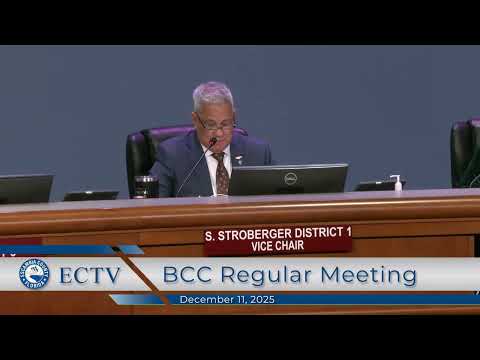
Escambia County commissioners voted unanimously Tuesday to broaden the county's definition of "camping" and to approve a related ordinance restricting use of medians, moves county officials say will give law enforcement clearer tools to address sidewalk encampments and dangerous median panhandling.
The camping ordinance amends the county's existing language so that "camping" can be enforced if officials reasonably observe someone using public rights-of-way or other covered locations as living space at any time of day, not only overnight. Allison, the county attorney, told the board the change reflects a statutory development and clarifies enforcement tools for situations where tents, blankets, storage of belongings or other setups are being used as living space.
"It shouldn't address simply the use of a tent," Allison said, describing the ordinance's focus on using public space as a living area rather than transient daytime activities.
The two public hearings brought sharply different accounts of the problem. Clay Romano, executive director of Waterfront Mission, said that people camping on sidewalks and rights-of-way pose safety and sanitation problems around his downtown shelter and urged a county-led, coordinated plan that pairs enforcement with services. "The status quo is neither compassionate nor sustainable," Romano said, adding that Waterfront Mission is willing to host coordinated outreach and that the county needs "sanctioned sites" and stronger outreach coordination.
Other residents framed the issue principally as a public-safety and quality-of-life problem. Jerry Price and Melissa Pino cited repeated trash, panhandling and people sleeping in medians and near roadways and urged stronger tools to keep sidewalks and medians clear. "The ordinance would help," Price said of the proposed changes.
Commissioners acknowledged the human-services gap many speakers described. Commissioner May said the county must pair enforcement with housing and services and asked for further discussion in committee. Commissioner Kohler and others emphasized intersections where people sleeping on medians pose a risk to motorists and pedestrians.
After discussion, Commissioner May moved to adopt item 05:32 (the camping-definition amendment); the measure passed 5-0. The board then considered item 05:33 (a median ordinance to address panhandling and use of medians) and also approved it unanimously.
What the ordinances do and what they do not - The camping amendment expands the time window for enforcement to daytime as well as overnight and clarifies behaviors that constitute "camping" (setup of bedding/tent, storage of belongings, and use of a public location as living space). County staff said officers would still exercise discretion and rely on reasonable observations. - The median ordinance restricts certain activities on medians to reduce safety hazards for drivers and pedestrians; it does not create new housing or shelter capacity.
Next steps and context County staff and commissioners said the policy changes are meant to provide clearer enforcement authority, while multiple commissioners requested follow-up work on expanding shelter capacity, coordinating outreach teams, and a committee-of-the-whole discussion tied to the upcoming budget cycle to address homelessness and housing affordability.
The board's vote was procedural and local; the county attorney noted that any further changes affecting unionized or constitutional-office staff would require bargaining or separate legal steps.