
Elmhurst District 205 approves $15M life‑safety bonds and $8.5M working‑cash bonds; one board member dissents
Get AI-powered insights, summaries, and transcripts
Subscribe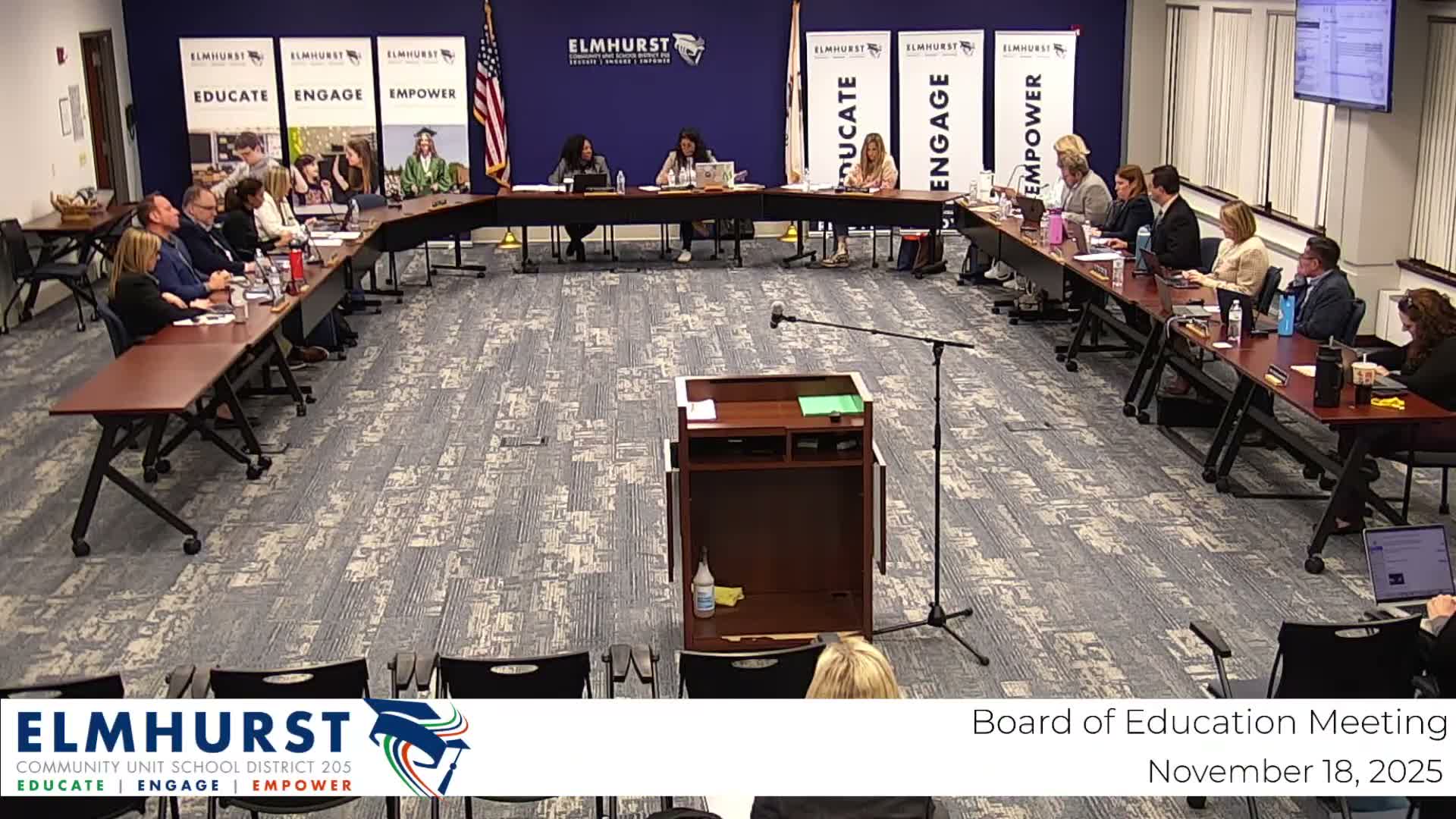
Summary
The board approved a $15 million life‑safety bond (Series 2025A) and an $8.5 million working‑cash bond (Series 2025B) to fund ISBE‑approved life‑safety projects and capital needs; interest rates were reported near 3.22% and 3.1% respectively; the votes were 5–1 (1 absent) on each bond.
Elmhurst Community Unit School District 205’s board on Nov. 18 approved resolutions to issue two series of general obligation bonds to pay for life‑safety work and to bolster working cash for capital projects.
Administration said the Series 2025A life‑safety bonds would not exceed $15,000,000 and are targeted to ISBE‑approved health and life‑safety projects identified in the district’s survey. "This $15,000,000 of life‑safety bonds is part of a larger scale of work — just over $20,000,000 estimated over the next five years," Mr. Blomquist said.
Elizabeth Hennessy presented the market results from a bond sale conducted that week, reporting an interest rate near 3.22 percent for the life‑safety bonds and about 3.10 percent for the working‑cash bonds; she noted the district’s Double A plus rating and compared spreads to similar recent Illinois issuances.
Board discussion touched on fiscal prudence and maintaining financial flexibility. One board member, identified as Courtney during the meeting, said she would vote no and reiterated questions she had raised in prior finance committee meetings. Other members praised staff work and the opportunity to secure favorable market rates; one board member said the life‑safety sale should not raise the tax burden for owners of a $500,000 home beyond the prior year’s bond portion.
The two bond resolutions passed on recorded votes with five ayes, one nay and one absence on each measure. Following the approvals, the board also approved a resolution to issue up to $8,500,000 in limited‑tax working cash bonds (Series 2025B) to support annual capital projects and stabilize fund balance.
These bond approvals are linked in the board’s presentation to the broader five‑year capital plan and the district’s goal of preserving operational flexibility amid rising expenditures.