Get Full Government Meeting Transcripts, Videos, & Alerts Forever!
Get email alerts on the Animal Shelter Contract topic
No spam. Unsubscribe anytime.
Shelton council hears proposal to contract shelter and animal-control services with local Humane Society
Summary
Council members reviewed a proposal from the Humane Society of Mason County to operate Shelton’s animal shelter and provide a dedicated animal-welfare officer; HSMC proposed a three-year contract and a 70% city partnership estimated at about $202,000 annually while promising medical capacity, foster/transfers, and programs to reduce animals’ length of stay.
Shelton city leaders on Dec. 9 discussed a proposal from the Humane Society of Mason County (HSMC) to operate the city’s animal shelter and provide animal-control services under contract. The presentation laid out HSMC’s staffing, medical capabilities and a proposed financial partnership in which Shelton would cover about 70 percent of operating costs — roughly $202,000 annually — under an initial three-year agreement.
The discussion came during a study session focused on persistent staffing shortfalls, maintenance problems at the 902 West Pine shelter, and rising calls for service. City staff told council members they currently lack a permanent animal-control officer and rely on shelter technicians, part-time staff, police and code-enforcement personnel to respond to complaints. Council members heard that average shelter stays rose from about 15 days in 2024 to 48 days in 2025 and that two dogs had been in the facility for roughly a year.
Katherine Johnson, executive director of HSMC, described the organization as “a local nonprofit animal welfare organization serving Mason County for more than 40 years” with licensed veterinary staff, foster and adoption networks, and community programs. Johnson said HSMC would manage daily intake and outcomes, on-site medical care, foster placement and transfer coordination, volunteer enrichment programs and community education aimed at keeping animals in homes.“Our main goal is to reduce that length of stay,” Johnson said, adding that faster access to veterinary care and an active transfer/foster network are key to getting animals into permanent homes more quickly.
City staff and HSMC officials emphasized the operational benefits of veterinary capacity on-site. Council members cited recent expensive emergency veterinary bills the city has paid as an example of potential savings under a contracted model. HSMC reported projected total operating expenses for the secondary location above $300,000 per year; the nonprofit proposed Shelton cover about 70 percent and said revenue offsets (adoptions, licensing, reclaim fees) would not materially reduce the city’s share in the near term.
Council members asked about the contract term and liability. Johnson proposed a three-year initial contract with annual checkpoints and noted HSMC carries insurance and would lease the facility separately from the services contract. When asked about euthanasia policy, HSMC said it maintains approximately a 97 percent “no-kill” rate and that euthanasia would be reserved for extreme medical or severe behavior cases. City staff read the current reclaim and disposition code aloud, noting owners may reclaim impounded animals within three business days of notification and that the code allows transfer to a registered nonprofit or euthanasia if the animal is unsuitable for adoption.
Several councilmembers expressed preliminary support. One presiding official summarized the council’s view as “a win for the dogs, win for the city,” and staff noted a projected first-year savings of about $56,000 compared with current shelter spending projections. Council members asked staff to prepare a formal contract and a cost comparison that would include: (a) contracting with HSMC, (b) shifting animal-control responsibilities into code enforcement, and (c) having the police department provide the service with trained officers. Staff said the transition would likely be phased, contingent on HSMC hiring and training staff for the location.
Next steps: council directed staff to bring back a contract draft, more detailed retrofit cost estimates for the shelter (including proposed safety upgrades such as guillotine doors and kennel covers), and a budget comparison of the alternatives discussed. No formal motion or vote was taken at the study session.
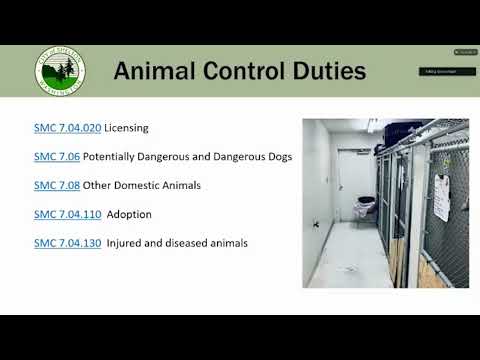
Reported authorities and rules in the discussion included Shelton Municipal Code provisions on pet licensing and impound/reclaim procedures (cited as chapter 7.04 in the presentation) and a referenced 2022 ordinance language to be checked by staff. The city’s current reclaim window (three business days) and disposition language were read into the record by staff.