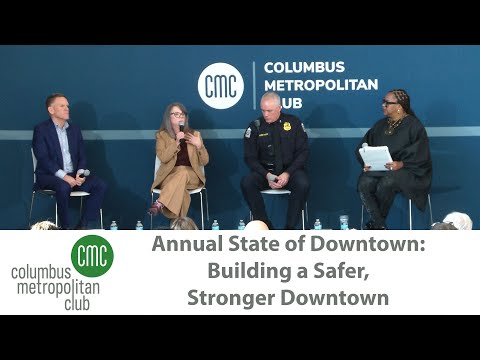
Panel: Downtown Columbus shows strong growth as coordinated safety program expands
Loading...
Summary
At a Columbus Metropolitan Club forum, Downtown Columbus Inc., Safer Downtown and the Columbus Division of Police outlined growth in housing, retail and jobs alongside expanded cameras, ambassador outreach and partnerships aimed at reducing violent and property crime.
Amy Taylor, president of Downtown Columbus Incorporated, told a Columbus Metropolitan Club forum that 'the state of downtown is very strong, but the exciting part is that the future is even better.' She outlined recent residential, retail and institutional gains and previewed infrastructure and safety efforts intended to support projected growth to 40,000 residents and 120,000 workers by 2040.
Taylor said downtown added roughly 770 new residential units this year, bringing the downtown residential total to about 13,500, and that about 90,000 employees work downtown. She reported about 11.5 million downtown commute trips this year and roughly 6.7 million visitors, and described more than $475 million in completed projects and about $1.72 billion in work currently under construction.
"Grocery stores, retail and a mix of housing and jobs are critical," Taylor said, announcing that Giant Eagle plans a roughly 20,000-square-foot store near downtown and noting projects such as the Pembroke and a Continental Tower conversion that add housing. She also highlighted education and health-care investments, including an OhioHealth commitment she described as a $400 million investment tied to Grant Medical Center and an OhioHealth–Columbus State public-private partnership she described at about $120 million to support a training pipeline and 166 units of workforce housing.
The forum shifted to public safety, where Greg Davies, CEO of Downtown Columbus Incorporated, said perception after the pandemic lagged behind official crime trends and that coordinated private–public security was intended to change that. "Success looks like people coming downtown, telling people it's safe and encouraging people to come downtown," Davies said, describing efforts to connect corporate, institutional and city cameras and to align private security, special-duty officers and city policing.
Robin Davis, executive director of Safer Downtown, described the program's ambassadors, street-cleaning crews, four outreach specialists from Mount Carmel who focus on homelessness engagement, and a command center in the Lazarus Building that aggregates camera feeds. "Safer Downtown's mission is simple: it is to create and maintain a safe, clean and welcoming city, period," Davis said. She said the command center operates roughly 150 cameras now, with a near-term goal of about 200, and that partners have shared private camera access to provide a continuous footprint of downtown.
Deputy Chief Smith Weir of the Columbus Division of Police outlined trends he described as encouraging: he said aggravated assaults in the downtown area are down about 15% this year, thefts from automobiles are down about 30%, burglaries down about 15% and overall violent crime 'roughly down.' He credited technology and rapid evidence-sharing with improved clearance rates, saying homicide clearance improved from about 50% in 2022 to about 85% today.
Panelists addressed privacy questions. Davis said the downtown cameras 'are not recording sound' and that operators monitor feeds to identify criminal activity; video is shared with Columbus Police and Fire departments for investigations and evidence. The group stressed that the ambassadors are not a police force but provide welcoming, preventive and supportive services, including escorts and connections to social services.
On governance and funding, panelists said Safer Downtown is funded through a mix of private partners and public support; Davies said the initiative received about $1.25 million from the state through a capital program for cameras. Davies also described an effort to petition property owners to secure long-term service funding and said the program aims to reach 60% of affected property-owner participation; he reported current support as roughly 35–40%.
During audience questions, panelists said planned City of Columbus rezoning changes would have limited effect inside the downtown core, which they described as already zoned to allow dense development. They pointed to the Capital Line and LinkUS transit investments, plus Vision Zero traffic enforcement, as the main efforts to improve walkability and pedestrian safety.
The forum closed with organizer Sofia Fifner thanking sponsors, recognizing this year's Smithy Award for the Gay and High Street redevelopment and urging attendees to use the Safer Downtown QR code to report problems or request assistance.
Next steps and follow-ups noted by panelists include near-term expansion of the camera network, the start of Capital Line construction (panelists said construction would begin next month), continued petitions of property owners to secure service funding and ongoing quarterly partnership coordination between DCI, Safer Downtown, large employers and city departments.