
Columbus officials outline $2.7 billion 2026 operating budget and a package of cuts and investments to close the gap
Get AI-powered insights, summaries, and transcripts
Subscribe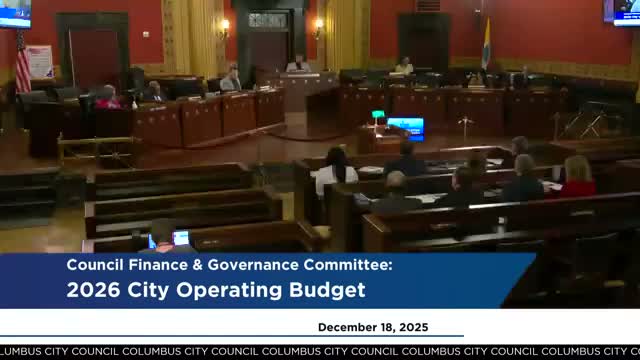
Summary
City finance officials presented the mayor's proposed 2026 operating budget (about $2.7 billion all funds, $1.26 billion general fund) and described balancing measures including removal of 200 vacant positions, a 15% cut to discretionary contracts, a lowered bargaining-unit increase (2%), $5 million for a resilient housing initiative and reductions to some public-health contracts.
Director Chris Long presented the mayor's proposed 2026 operating budget to the Columbus City Council finance hearing, saying the plan totals roughly $2.7 billion across all funds and that the general fund constitutes about 47% of that total. "One was to safeguard all current city staffed positions. In other words, no layoffs," Long told the council as he described the administration's guiding principles.
The administration framed 2026 as a tight budget year driven by personnel and insurance costs that outpace forecasted revenue growth. Long told the panel that personnel accounts for about 75% of the general-fund budget and that departments are budgeting a 19% increase in insurance costs for 2025 that will add roughly $23 million in department expenses. To close the gap, the mayor's proposal removes more than 200 currently vacant full-time general-fund positions, which Long said produces approximately $16 million in 2026 savings.
Long outlined other measures: shifting eligible expenses to the income-tax set-aside and other non-general funds (about $25 million budgeted there), a 15% reduction to discretionary departmental contracts (estimated $5 million in savings, including a $1 million reduction to development social-service grants), and cutting the proposed bargaining-unit increase to 2% (about $2 million in savings) from an earlier 3% assumption. He also noted a $2.3 million reduction in contract support for Columbus Public Health's Federally Qualified Health Centers and continued investments in public-safety recruitment and technology.
The administration highlighted several planned additions despite constraints: two police recruit classes totaling about 120 prospective officers, one fire recruit class of roughly 45 recruits, a $5 million "resilient housing initiative" to replace expiring federal rental assistance, investments to support the city's zero-trust cybersecurity network, and an approximate $1.5 million operating allocation for the Kilburn Run Sports Park scheduled to open in 2026.
Auditor Kilgore said her office submitted a "lean" budget and emphasized modernization gains the office has achieved. "Electronic filing has grown from 13% last year ... to 70% this year," she said, arguing that modernization reduces cycle times and improves collections. The auditor and treasurer both described continued work to accelerate digital payments and expand ACH to reduce manual processing.
Council members pressed administration officials on implementation details. Chair Bankston and others sought confirmation that removed positions are vacant only and will not cause layoffs; Long confirmed the intent is to remove currently vacant roles and to work with departments case by case on refill requests. Long and other officials said they attempted to "hold harmless" training and licensure line items where required certifications exist.
Councilmember Green urged more transparency on discretionary-contract cuts and warned of harm to nonprofit and clinic partners, saying the line-item readouts she cited reflected steep reductions to community services. Long said departmental directors will participate in follow-up briefings and that cuts will be considered through the mayor's strategic priorities framework.
Chief Information Officer Sam Orth described the Department of Technology's request of $72,424,262 for 2026 (about an 18% increase), attributing much of the change to personnel-health costs, software-licensing inflation and debt-service tied to cybersecurity investments. He told council that software providers are passing AI- and cloud-related infrastructure costs through licensing and that the city faces rising vendor costs across both hardware and software.
Treasurer Talia Brown told the committee the treasury's investment portfolio is approximately $2.6 billion and described steps to modernize cash collection, such as smart safes and expanded digital-wallet acceptance, while noting security and fraud controls constrain vendor ACH rollout.
The hearing closed with an announcement that the council will hold additional department- and topic-specific budget hearings in January. No formal votes were taken at the hearing; council will continue deliberations and public engagement before any final appropriations are adopted.