
Lane County staff warn of up to $5 million general fund shortfall for 2026–27
Get AI-powered insights, summaries, and transcripts
Sign Up Free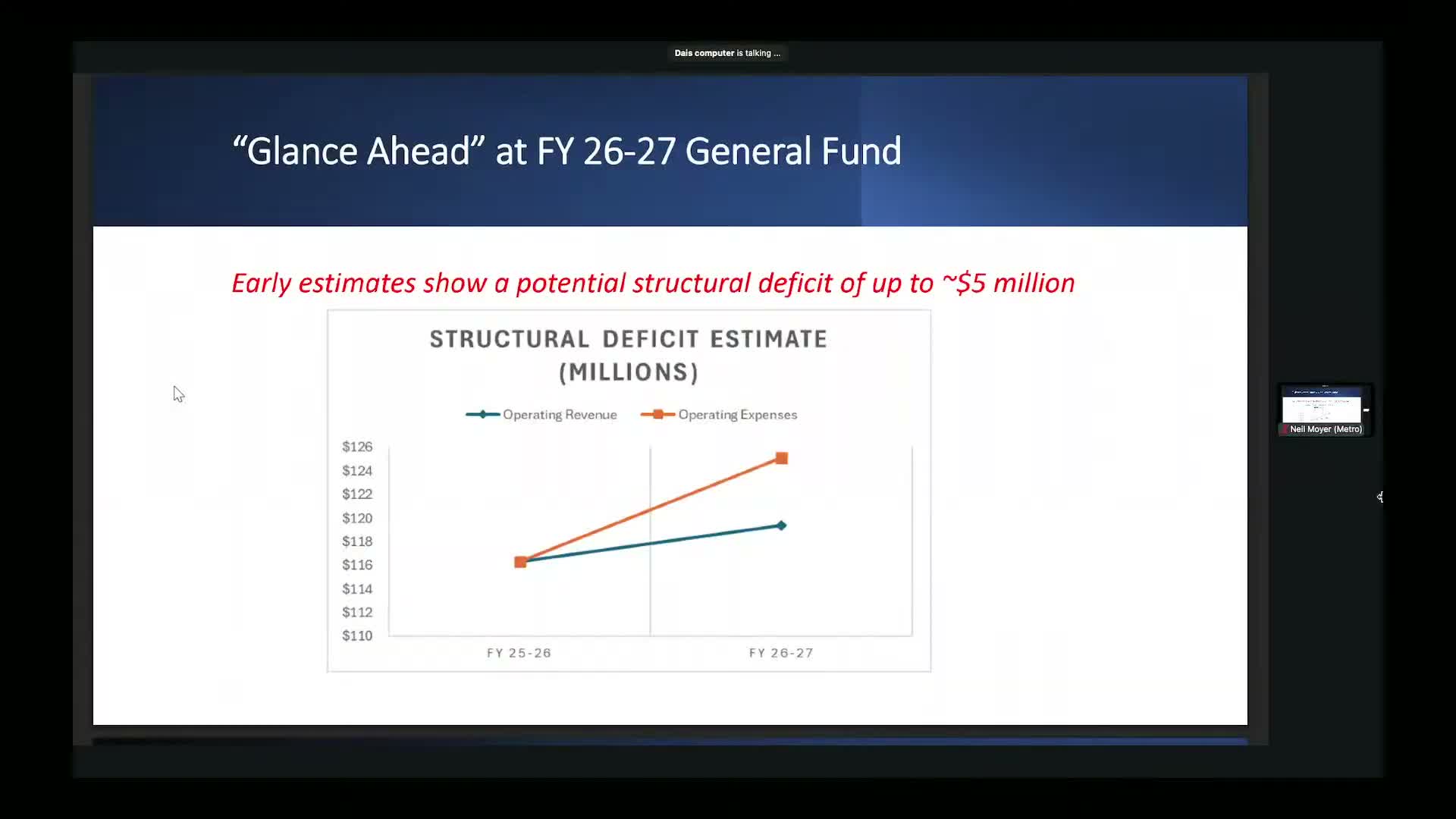
Summary
County budget staff told commissioners on Dec. 16 that early estimates show a potential $5,000,000 structural deficit in the 2026–27 general fund and outlined options including targeted reductions, vacancy budgeting and legislative advocacy; no decisions were requested at the session.
Lane County budget staff told the Board of County Commissioners on Dec. 16 that early estimates show a potential structural deficit in the 2026–27 general fund of up to $5,000,000. County Administrator Mr Mokurais and budget manager Christine Moody said the meeting was intended to begin planning, not to seek immediate direction.
The county emphasized that the general fund is only one of about 35 funds the county manages but is the primary repository for property-tax revenue the county controls. “We keep about 11 to 12 cents on the dollar,” staff said, explaining that most property-tax revenue collected in Lane County flows to other taxing districts and that the general fund is where the board has the most discretion.
Christine Moody presented the early projection and cautioned the estimate is preliminary: "Early estimates show that the potential structural deficit in the general fund could be up to 5,000,000," she said, and added the figure does not yet reflect a vacancy variance or last-minute departmental revenue adjustments. Staff said they will apply vacancy variance assumptions (historically about 3.5% to as high as 5–5.5%) and continue to refine departmental revenue entries before the January leadership kickoff.
Staff outlined three main forces driving the shortfall: a structurally limited property-tax system that typically allows only 3–3.5% annual growth, recent reductions in federal and state funding, and Lane County’s unique combination of large geography with both urban and rural service responsibilities. The presentation showed that public safety consumes the largest share of discretionary general-fund dollars and that many of those services are connected to state mandates or state-funded programs.
Moody provided model scenarios to illustrate trade-offs. An across-the-board reduction large enough to close a $5,000,000 gap would be roughly a 6.67% cut to discretionary general-fund allocations, with examples such as roughly $1,000,000 from 9-1-1 response and $783,000 from jail services in that hypothetical. Alternatively, excluding public safety from reductions would shift much larger proportional cuts to remaining services.
Commissioners said they want public engagement and clearer priority data before weighing major structural choices. Chair asked staff to include public-sentiment work and noted key dates in January when leadership and departmental budget development will resume. No formal motions or votes were taken at the work session.
Why this matters: County leaders said the combination of statutory limits on property-tax growth, the county’s relatively low permanent property-tax rate, and continuing state and federal funding reductions leave little room for the kind of cuts that would not reduce services residents rely on. Staff recommended continued modeling, use of vacancy variance where appropriate, targeted efficiency measures and continuing advocacy with state legislators.
The board directed staff to return with updated numbers after the January leadership kickoff and with options informed by employee and public input.