Get Full Government Meeting Transcripts, Videos, & Alerts Forever!
Get email alerts on the Captive Insurance Modernization topic
No spam. Unsubscribe anytime.
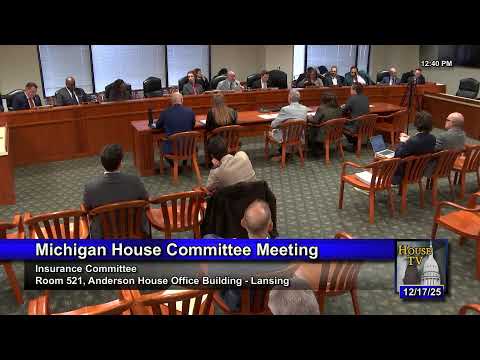
Committee hears DIFS and industry testimony on captive-insurance modernization package
Summary
Sponsors and Department of Insurance and Financial Services presented a seven-bill package (HB 53-80 through HB 53-86) proposing modernizations to Michigan captive-insurance law, including lower application fees, a flexible renewal deadline, broader sponsor definitions, and removal of an in-state board meeting requirement.
The House Insurance Committee spent the latter portion of its meeting hearing testimony on a seven‑bill package (House Bills 53-80 through 53-86) intended to modernize Michigan law for captive insurance domiciles. Sponsors and Department of Insurance and Financial Services (DIFS) staff said the changes aim to make Michigan more competitive as a domicile and to clarify regulatory expectations without weakening consumer protections.
Rep. Tisdale, a package sponsor, framed captives as licensed insurers owned and controlled by their insured entities and said the bills would expand who may serve as sponsors or captive managers, producing economic benefits and jobs if more captives choose Michigan as their domicile. Rep. Carter highlighted two bills in particular (HB 53-84 and HB 53-82) that would update requirements for sponsored captives and special-purpose financial captives and said the package preserves DIFS oversight and consumer protections.
Jenny Geese, legislative liaison manager at DIFS, summarized key policy changes: broadening the definition of sponsors, allowing more flexible renewal timing by permitting renewal filings 90 days after a captive’s fiscal-year end rather than a fixed March 1 date, lowering the application fee from $10,000 to $5,000, and streamlining exemptions and waivers. Geese said Michigan currently domiciles 27 captives and that captive premiums in Michigan exceeded $3,000,000,000 in 2023 (a 25% increase over the prior year), figures she gave as context for the proposals.
Greg Nowakowski of Honigman (identified in committee remarks and later testifying) said he supports the reforms, compared Michigan’s captive count to larger domiciles such as Vermont, and recommended clarifying statutory language related to what a captive may write under a limited certificate of authority when a commercial carrier and a captive share a workers’ compensation exposure (for example, whether a deductible portion can reside with the captive). Committee members asked how Michigan would compete with more established domiciles; witnesses said DIFS and industry representatives attend national captive conferences to promote statutory updates and court prospects to prospective owners. DIFS confirmed one statutory change in the package would eliminate the requirement that a captive’s board meet physically in the state each year, providing flexibility for captives with non-calendar fiscal years.
No committee vote on the captive package was recorded in the transcript; sponsors and DIFS remained at the table after testimony in case members had further questions. The committee adjourned after taking the earlier votes on HB 52-98 and HB 52-99.
Next steps: the bills are in committee; sponsors and DIFS signaled support and offered technical clarifications that bills’ drafters may incorporate before further action.