Get Full Government Meeting Transcripts, Videos, & Alerts Forever!
Get email alerts on the Parking Rates topic
No spam. Unsubscribe anytime.
Norwalk parking authority approves multi-site rate increases to fund repairs; changes effective July 1, 2026
Summary
The Norwalk Parking Authority unanimously approved hourly and permit rate increases across downtown facilities, citing rising demand, nearby development and the need to fund structural and lighting repairs; the changes are slated to go into effect July 1, 2026.
The Norwalk Parking Authority voted unanimously to adopt a package of parking rate increases intended to raise revenue for structural repairs, lighting and other facility improvements.
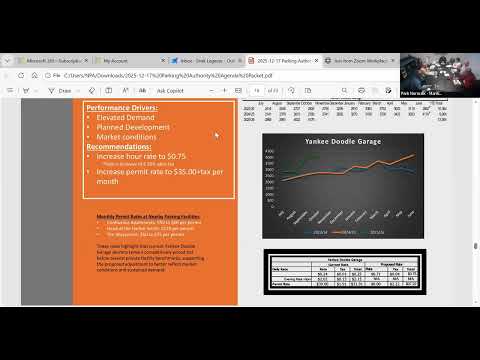
At a December meeting, staff presented proposed adjustments across multiple facilities, saying they were driven by increasing demand and nearby development. "What we're recommending for the Yankee Doodle garage is an increase in our hourly rate to 75¢ from the current 25¢, and that 75¢ includes some 6.35% in tax, and then also increase the permanent rate from the current $30 to about $35," a presenter summarized during the packet review.
The authority framed the increases as incremental and tied to reinvestment. Jim Travers, director of transportation, mobility and parking, told members the authority has completed two condition assessments over the past four years and needs ongoing revenue for both visible upgrades and behind-the-scenes structural work. "The only way to do that is to have revenue because the only repairs come from the revenue that gets collected," Travers said, describing recent structural and lighting work and planned interior improvements.
Board members pressed staff for data to justify the increases, asking how much of garage use comes from Norwalk residents versus regional visitors. Staff said current origin estimates come from payment ZIP-code data and that system-wide nonresident usage is roughly 60 percent; staff committed to producing more granular origin data as it becomes available.
Staff also detailed other site-specific proposals: raising midstream/Wall Street-area hourly rates (from $0.60 to $0.75 in some lots), aligning certain on-street Wall Street district rates toward $1 per hour, and adjusting the South Norwalk (train-station) garage to a $16 rate for stays of 24 hours or more while retaining the current daily-max structure. Monthly permits at the train-station garage were noted to remain at $99.
Some members voiced concern about the size of the jump at individual locations. "75¢ feels like a lot," one member said during discussion. Staff replied the proposed rates remain below many neighboring jurisdictions and that modest annual adjustments are preferable to a single large increase.
The board also discussed nonrevenue uses of space, including police-impounded vehicles that occupy secured roof spaces while investigations are active; staff said roughly 14 spaces can be used for that purpose and are not typical revenue-generating stalls.
A motion to approve the presented rate changes for inclusion in the FY 2026–27 budget passed by unanimous vote. Staff said the adopted rates are planned to take effect on July 1, 2026. Members also requested follow-up reports on occupancy monitoring, origin-data analysis and the condition-assessment timeline.
Beyond rates, members discussed streetscape improvements — one member proposed the parking authority consider funding street trees on a bleak stretch of Main Avenue — and staff described planned aesthetic and safety upgrades, including new lighting and refurbished passageway finishes.
The authority adjourned after agreeing to return with the requested data and project updates.