Get Full Government Meeting Transcripts, Videos, & Alerts Forever!
Get email alerts on the Housing Court topic
No spam. Unsubscribe anytime.
Cranston council asks state for authority to create housing‑court division after heated debate
Summary
The Cranston City Council voted to ask the Rhode Island General Assembly for enabling legislation to allow a housing‑court division in the municipal court. Supporters said it would give inspectors more enforcement tools; opponents warned of potential costs and urged workshops first.
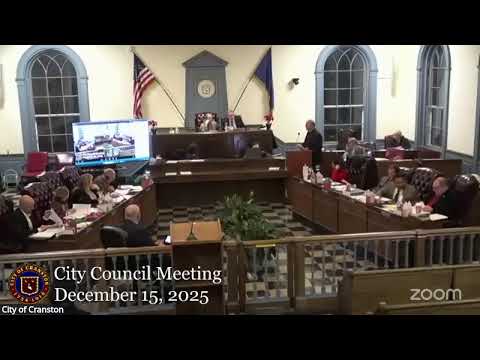
The Cranston City Council voted Dec. 15 to ask the Rhode Island General Assembly for enabling legislation to permit a housing‑court division within the municipal court.
Supporters, including Councilman Traficante and Council Vice President Haroyan, said the request would give the city additional tools to address long‑neglected, abandoned and dangerous properties. Traficante described homes that had been abandoned for years and said the proposal would “put some more teeth into the fine structure” used to protect neighborhoods. Haroyan said the measure only asks the state to authorize the city to pursue options, not to commit local funds now.
Opponents, led by Councilman Campopiano, said the change could increase municipal costs and duplicate existing remedies. “I think this is gonna cost the city money,” Campopiano said, arguing the city already has mechanisms such as receivership and existing municipal court jurisdiction. He asked for a workshop to hear from judges and inspectors before moving forward.
Council members repeatedly clarified that the resolution asks only for enabling legislation from the General Assembly, not for the council to create or fund a new court immediately. Council members who supported the measure said that language would allow future drafting, public workshops and cost estimates after the state grants authority.
After extended debate that reviewed examples from neighboring communities and local inspection practices, the council adopted the resolution in a roll‑call vote. One council member recorded a dissenting vote; the motion otherwise carried.
The next procedural step is the city’s request to the General Assembly; any specific ordinance, pilot design, staffing plan or budget implications would be subject to future council review and public hearings.