
Committee hears divided testimony on bill to let Mackinac Island clarify authority over ferry fees
Get AI-powered insights, summaries, and transcripts
Sign Up Free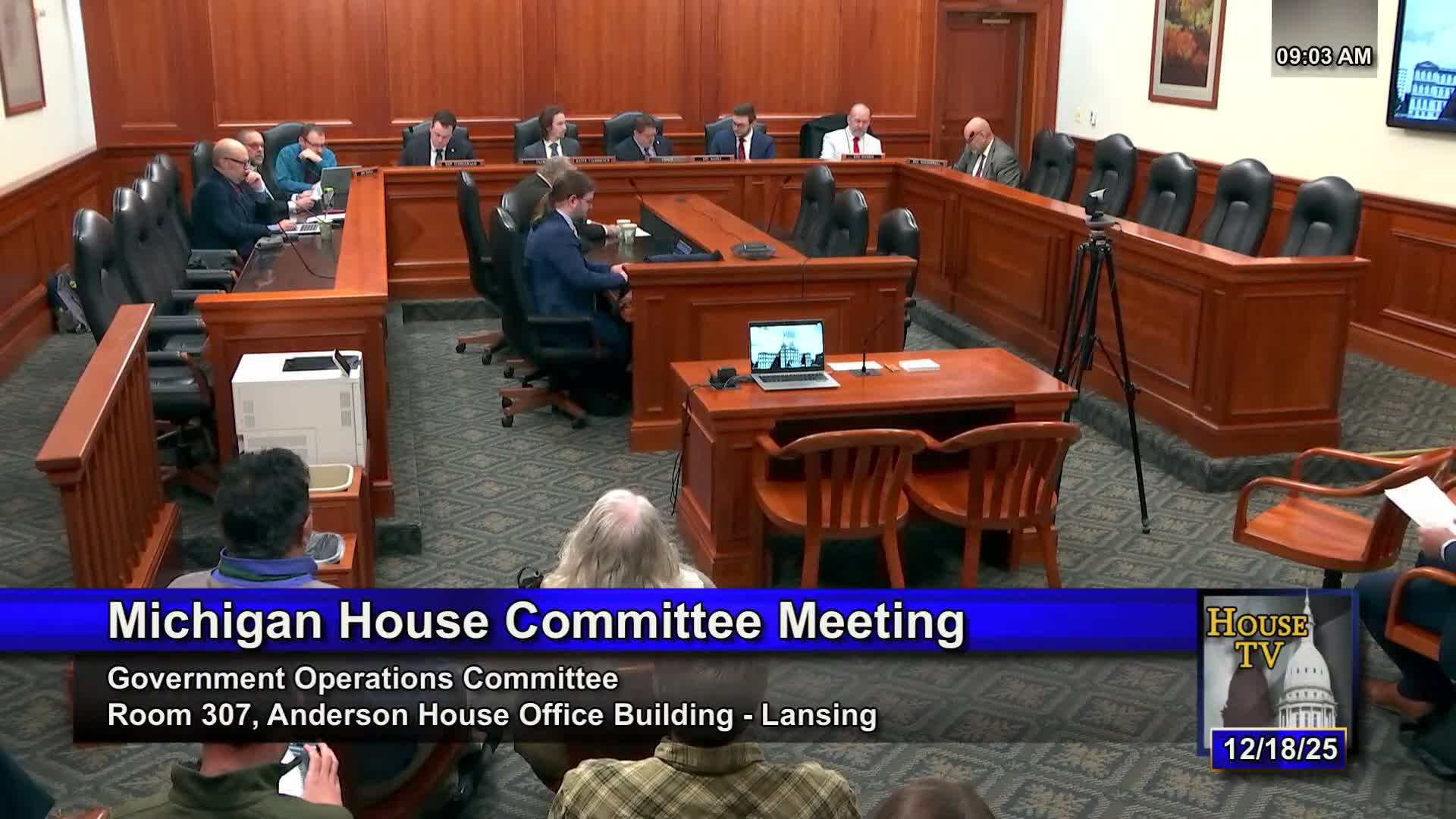
Summary
Lawmakers heard competing testimony on SB304, which would let Mackinac Island place charter language on a local ballot to clarify that ferry fares, parking and ancillary fees fall under the city’s regulatory authority. Supporters cited consolidation and sharp fare hikes; opponents raised constitutional and contract-related legal objections.
LANSING — The Michigan House Government Operations Committee heard more than two hours of testimony on Senate Bill 304 on Wednesday, as island residents, business owners and ferry representatives clashed over whether Mackinac Island should be allowed to place charter language on its local ballot clarifying that ‘‘all aspects of ferry service’’ — including ancillary fees and parking — are subject to city regulation.
Sen. Demuse, sponsor of SB304, told the panel the bill’s sole purpose is ‘‘to allow the city of Mackinac Island the opportunity to update their charter’’ and to put proposed language before the city’s voters. ‘‘That is all this bill does,’’ he said, adding the change would not give any government new powers to set prices beyond what already exists in state law.
Supporters described a recent consolidation of ferry operations that they say left the island effectively uncompetitive. Dennis Cawthorn, an uncompensated volunteer for the city, said he and other island residents have seen rapid price changes since the Hoffman family of companies acquired multiple ferry operators and docks in 2024. ‘‘One private company now owns all of the ferries and even more importantly, all of the ferry docks on Mackinac Island,’’ Cawthorn said, arguing that consolidation eliminated meaningful competition and allowed operators to shift costs into parking and other fees.
Mike Kavanaugh, longtime outside counsel to the city, traced the legal history backing the city’s authority to license and regulate ferries to 1899 and to subsequent court rulings. He said the city has amended its ferry code to review prices and that, pending litigation notwithstanding, the charter amendment would make explicit that ‘‘all cost associated with the ferry service’’ — such as baggage charges, priority boarding and parking — can be regulated. Kavanaugh told lawmakers the current franchise expires in June 2027 and that some actions by operators prompted the city to seek clarity and new local controls.
Businesses and tourism stakeholders described practical impacts. Tim High, executive director of the Mackinac Island Convention and Visitors Bureau, said complaints rose after the acquisitions and that families and school groups were being priced out. Mark Ware, CEO of Mission Point Resort, said his employer absorbed what he described as ‘‘an increase of over $18,000 in ferry tickets and parking expenses for our employees’’ compared with the prior year and blamed the consolidation for reduced incentives that previously kept costs down.
Opponents — including ferry operators and public‑policy groups — urged caution and legal scrutiny. A Sheplers representative (identified in the record as Steve Bridal and earlier as Steven Liddell) told the committee the bill could be legally overbroad, potentially extending Mackinac Island’s regulatory reach onto mainland ports and conflicting with existing franchise agreements that run through 2027. The representative cited the Carriers by Water Act (Public Act 246 of 1921) and said state and federal court proceedings have already raised doubts about whether the city may unilaterally reclassify competition or enforce rate limits. ‘‘This is a rate regulation bill. It’s not a promote‑competition bill,’’ a policy witness added.
Several legal commentators warned of constitutional and statutory pitfalls. Counsel and public commentators cited Article IV, §29 of the Michigan Constitution (prohibiting local or special acts where a general act can be applied) and Article I, §10 (contracts) as potential barriers, and referenced ongoing federal litigation in which a district judge made preliminary findings the city could not unilaterally declare a lack of competition.
The committee heard questions from members about scope (whether cruise‑ship tenders or air service would be affected), the history of baggage and priority‑boarding fees, whether parking on the mainland is owned by ferry companies or other entities, and alternatives to regulation such as promoting market entry. Witnesses said parking and some fees were newly deployed after consolidation, that air service is not a practical substitute for most visitors, and that the city had hired a regulatory adviser to design a process similar to utility review if regulation is used.
No vote on SB304 occurred; the committee’s chair acknowledged a substitute bill from Rep. Fairburn that was not taken up that day. The panel listed several submitted statements for the record from hotels and industry associations and adjourned.
The next procedural step was not set on the record; proponents asked lawmakers to give Mackinac Island residents the chance to vote on charter language and opponents urged a Lansing‑wide or judicially vetted solution to avoid conflicts with existing contracts and state law.