
District recommends continuing partnership with Lexington County Mental Health after cost-effectiveness review
Get AI-powered insights, summaries, and transcripts
Subscribe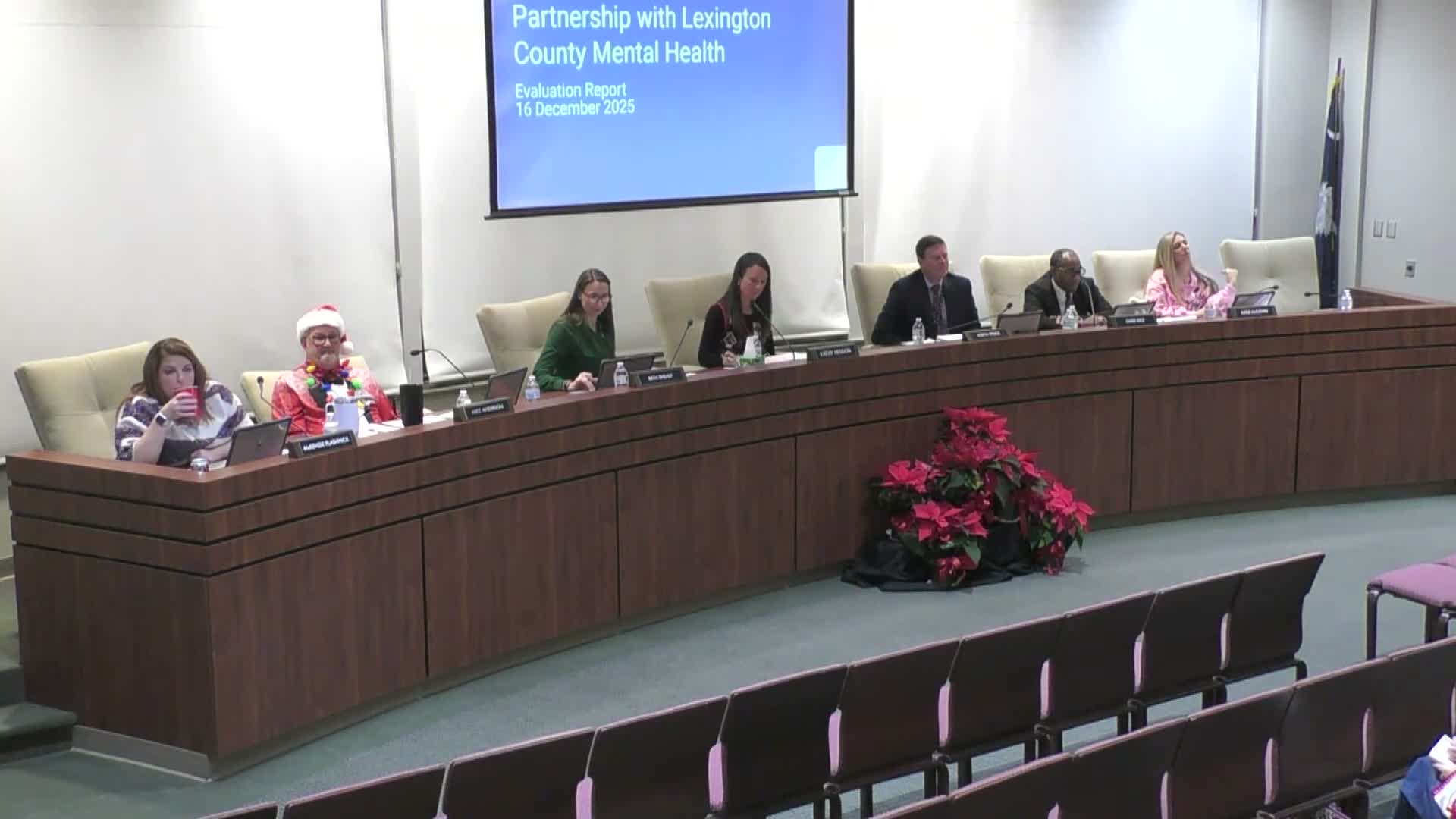
Summary
The board reviewed an evaluation of the district—s partnership with Lexington County Mental Health: the program costs about $360,000 annually, staff said it is far less costly than hiring equivalent counselors internally and recommended continuing the partnership while expanding staffing and family outreach.
The Lexington County School District One board heard an evaluation of its partnership with Lexington County Mental Health (LCCMHC) on Dec. 16 and was advised to continue the agreement because it provides school-based mental health services at lower cost than hiring equivalent staff districtwide.
Dr. Shane Phillips presented the evaluation, describing an upward trend in demand for mental-health services and noting the district conducted 696 suicide-risk assessments in 2024–25, with each assessment taking an estimated four hours to process. "Our current partnership within the district costs us $360,000 a year," Phillips said, and he contrasted that figure with an estimated $1.8 million cost to hire equivalent counseling staff internally.
Representatives from Lexington County Mental Health explained operational constraints: the agency tries to keep active caseloads near 60 clients per clinician and does not currently have on-hand staff to immediately expand assignments to all schools; adding more school-based clinicians would require recruitment and hiring. Sarah Main, identified in the presentation as the agency director, said new positions had been added in prior years and could be added again but would take time.
Board members asked whether the national prevalence ("one in five" students diagnosed with a mental-health condition) matches district data; presenters said district-specific case numbers were not immediately available but confirmed an upward trend locally. Trustees pressed on capacity, caseload definitions, and whether additional funding or recruitment could change the program—s reach.
Recommendation and next steps: presenters recommended continuing the LCCMHC partnership, working to ensure full staffing, and increasing family education about available services. The board did not take a vote to modify the partnership at the Dec. 16 meeting.