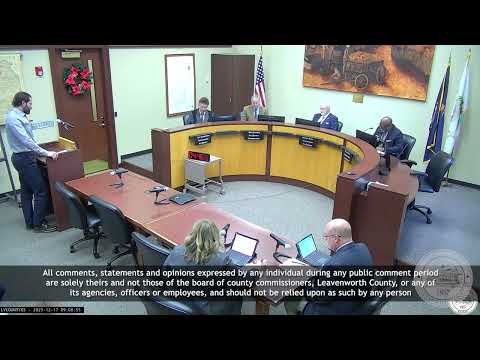
Leavenworth County commissioners approve nonbinding letter of interest to learn more about proposed TerraPower 'Natrium' reactor
Loading...
Summary
After public comment and extended debate, the Leavenworth County Board of Commissioners voted 3–2 to approve a nonbinding letter of interest so local economic development officials can seek more information about a proposed TerraPower Natrium reactor; opponents cited safety, waste and transparency concerns.
The Leavenworth County Board of Commissioners voted 3–2 to approve a nonbinding letter of interest that will allow county economic development officials to obtain more detailed information on a proposed TerraPower Natrium reactor and to participate in follow-up briefings.
The vote came after more than an hour of public comment and discussion. Cecilia Pruitt, a Leavenworth resident, told commissioners the Natrium design uses liquid sodium cooling and quoted a Union of Concerned Scientists expert she said warned the design has “major safety flaws compared to conventional nuclear reactors.” "Liquid sodium reacts violently with water and with oxygen, potentially causing fires and explosions," Pruitt said during public comment. She also raised concerns about aquifer use and regional seismic risk.
Jeremy Greenemeyer, who identified himself as speaking for his family and businesses, urged the commission to pursue a fact‑based review rather than taking an immediate position. "Agreeing to study a proposal or sign a letter of interest does not obligate the county to move forward," Greenemeyer said, framing the letter as a way to secure information to evaluate fiscal impacts, tax benefits and long‑term reliability.
Bridal Haveian, identified as board president of the Leavenworth County Development Council (LCDC), told the commission the state Department of Commerce posted a request for information called "Project Sandpiper" that asked for 80–120 acres and access to large transmission lines. He characterized the county’s proposed letter as nonbinding and necessary to be included in the next round of briefings and group sessions with the state and developer.
Opponents on the board said the process felt rushed and that a letter of interest could advance the project before the county had adequate information on waste storage, transportation risks and safety standards. "This is not a little decision," Commissioner Steven said, urging a work session and outside expert testimony. Several commissioners requested briefings from university and technical experts and said they wanted community input before committing to any project.
County counsel told commissioners that state statute allows nonbinding advisory elections under certain procedures if the board wanted to seek formal public input later.
The final motion to approve sending a letter of interest to LCDC carried 3–2. Commissioners who voted in favor said the step only opens access to information; those opposed said they feared the action would be perceived as advancing siting without adequate analysis. Following the vote the board recessed for 10 minutes and directed staff to schedule further briefings and a possible work session to address safety, waste disposal, emergency response and fiscal questions.
The letter approved is explicitly nonbinding; commissioners and LCDC representatives said it does not commit county funds or land and that any subsequent action would require further authorizations.