Get Full Government Meeting Transcripts, Videos, & Alerts Forever!
Get email alerts on the Board Governance topic
No spam. Unsubscribe anytime.
Newington board receives legal briefing on FOIA, FERPA and board duties
Summary
At a Dec. 10 special meeting, attorney Jessica Ritter briefed the Newington Board of Education on members’ statutory role, confidentiality rules under FERPA, and broad FOIA obligations that can make personal emails and texts discoverable; there was no public comment and the board adjourned after the training.
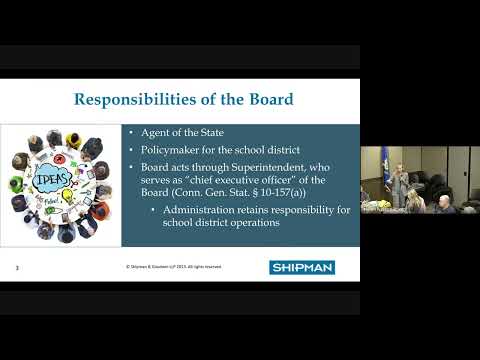
Attorney Jessica Ritter of Shipman & Goodwin told the Newington Board of Education at a Dec. 10 special meeting that local school boards are "an agent of the state" and should prioritize students’ educational interests when making policy.
Ritter opened a roughly one-hour legal briefing for the board retreat, reviewing members’ core duties, limits on access to personnel files, rules for executive session and the legal risks of using personal devices for board business. "As a local board of education, you are actually deemed an agent of the state," she said, adding that the superintendent is the board’s only direct employee and that board members must rely on the superintendent to implement policy.
On student confidentiality, Ritter cited FERPA to explain that even information provided privately by a parent cannot be re‑disclosed without proper consent. She told members they may receive limited information only when it is appropriate to their role — for example, a board member is entitled to the superintendent’s evaluation but not to individual teacher evaluations without consent.
A substantial portion of the briefing focused on Freedom of Information obligations. Ritter warned that "emails and texts that deal with board business," even when sent from personal accounts or phones, are potentially discoverable in an FOI request and that board members could be required to search personal devices. "If you don't want the [public] to see it or publish it, don't put it in writing," she said, urging the use of district email for board business.
Ritter also reviewed practical meeting rules: agendas must give the public enough detail to understand the business to be transacted; regular meetings should be filed with the town clerk by Jan. 31 for the ensuing year; agendas must be posted at least 24 hours and remote meeting links provided at least 48 hours in advance. She warned that committee meetings only recommend to the board and do not carry binding authority unless they become a posted meeting because of added participants creating a quorum.
The attorney addressed executive sessions and legal thresholds for their use, noting a two‑thirds vote is required to enter executive session and that allowable topics are narrowly defined (attorney–client communications, pending litigation identified by case, confidentiality of student and personnel records, etc.). She recounted a case in which inviting a superintendent into executive session produced a FOIA ruling because the invited official did not speak, a fact the commission judged significant.
Board members asked clarifying questions through the session. Ritter gave several scenarios — including a hypothetical in which members text during a budget presentation — and warned that secretive side discussions or texting during public meetings can trigger FOIA complaints even when no quorum is present.
There were no public commenters in the room or online. The board opened the floor for remarks from members (none offered) and then approved a motion to adjourn. The meeting ended shortly after the training.