Maine PFAS advisory committee reports land purchases, grants and testing rollout as fund balance and rule changes draw attention
Loading...
Summary
PFAS Fund staff told the advisory committee the Fund has bought contaminated farmland, will seek leases for corn production with monitoring, opened research grant RFAs, and is expanding blood serum testing outreach; members asked for more data on fund interest and statutory scope before advising on broader uses.
The PFAS Advisory Committee met Dec. 15 to hear a detailed update from Beth Valentine, director of the PFAS Fund at the Department of Agriculture, Conservation and Forestry (DACF), on land acquisitions, research grants, and blood-serum testing enrollment.
Valentine told the panel the Fund has provided “about $2,300,000 in direct financial assistance since the program launched in March 2024,” including income-replacement payments, administrative grants and professional services. She said the Fund has purchased a Palermo property and is finalizing an environmental covenant that will bar groundwater extraction and residential, school and childcare uses and require agricultural activities to follow PFAS soil and groundwater guidance and an approved stewardship plan. “We are getting close to advertising the lease for that and hope to have it in place so that cultivation can begin this spring,” she said.
Why it matters: The department’s goal is to return PFAS‑impacted land to agricultural production when possible while managing food‑safety risk. Valentine said measured PFOS and PFOA levels in the Palermo field (reported in the transcript at roughly 12–13 parts per billion) make hay production unsuitable for dairy but may permit corn production because of a lower transfer factor into grain; any lease would require coordinated monitoring of harvested products and animal products derived from animals that consume that crop.
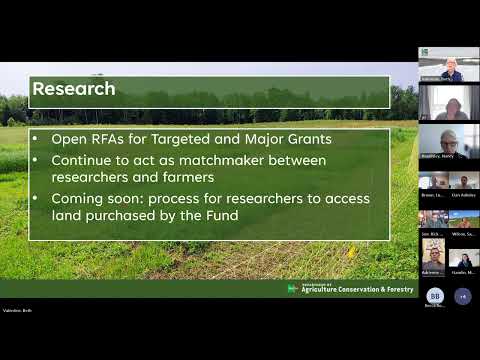
Valentine also summarized research and outreach work: two RFAs are open (targeted awards up to $100,000 and major awards between $100,000 and $500,000), with about 40 pre‑proposals received and full proposals due Feb. 13. DACF will maintain a list of farmers willing to host research or provide samples and act as a matchmaker between researchers and farmers while protecting the privacy of identified, PFAS‑impacted landowners.
On blood‑serum testing, Valentine recited current eligibility thresholds: “individuals whose water tests above 20 ppt for the sum of six PFAS or whose soil tests above 170 (transcript: ‘170 ppp’) PFAS” are presumptively eligible for Fund‑paid testing. She said direct mail outreach to 614 presumptively eligible households at the end of September produced 83 responses identifying 336 individuals; authorization forms have been sent to those people, who then take the form to their primary care provider to order the test. Valentine said Rule 407 (the Fund rule governing blood‑serum testing) allows waivers for cases that do not meet numeric thresholds but have a credible exposure route, such as a hunter regularly harvesting game from contaminated land, and that the waiver process will be posted publicly.
The Fund will also partner with Maine Mobile Health to collect authorized blood samples at the agricultural trade show in January 2026. Valentine said there has been broader interest in testing than the Fund can currently support: “To date, I think there have been ... 42 inquiries,” and about 14 of those were from people who do not meet the Fund’s numeric eligibility standards.
Clarifying finance figures: committee members asked about remaining funds. Valentine said $18,600,000 of the original $60,000,000 has been encumbered, leaving $41,600,000 available. The transcript also contains two related expenditure figures (an earlier spoken figure of about $2,300,000 in direct assistance and a later remark that $2,800,000 has been expended), which the department should reconcile when providing final accounting.
What’s next: Valentine said revisions to chapters 400–408 of the Fund’s rules are being finalized; chapters 400–406 received no public comments and will move forward, while chapters 407 (blood testing) and 408 (mental health services) drew comments requesting expanded eligibility and will receive an additional 30‑day comment period. Staff will also post procedures for researchers seeking access to Fund‑purchased land and a formal waiver procedure for blood testing eligibility.
The committee asked staff for additional materials — including legal clarity on statutory authority, comparables for how other state funds use interest earnings, and a reconciliation of recent expenditure figures — before taking any advisory position on expanded uses of the Fund.