
North Clackamas reports sustained literacy gains after multi-year coaching, curriculum push
Get AI-powered insights, summaries, and transcripts
Subscribe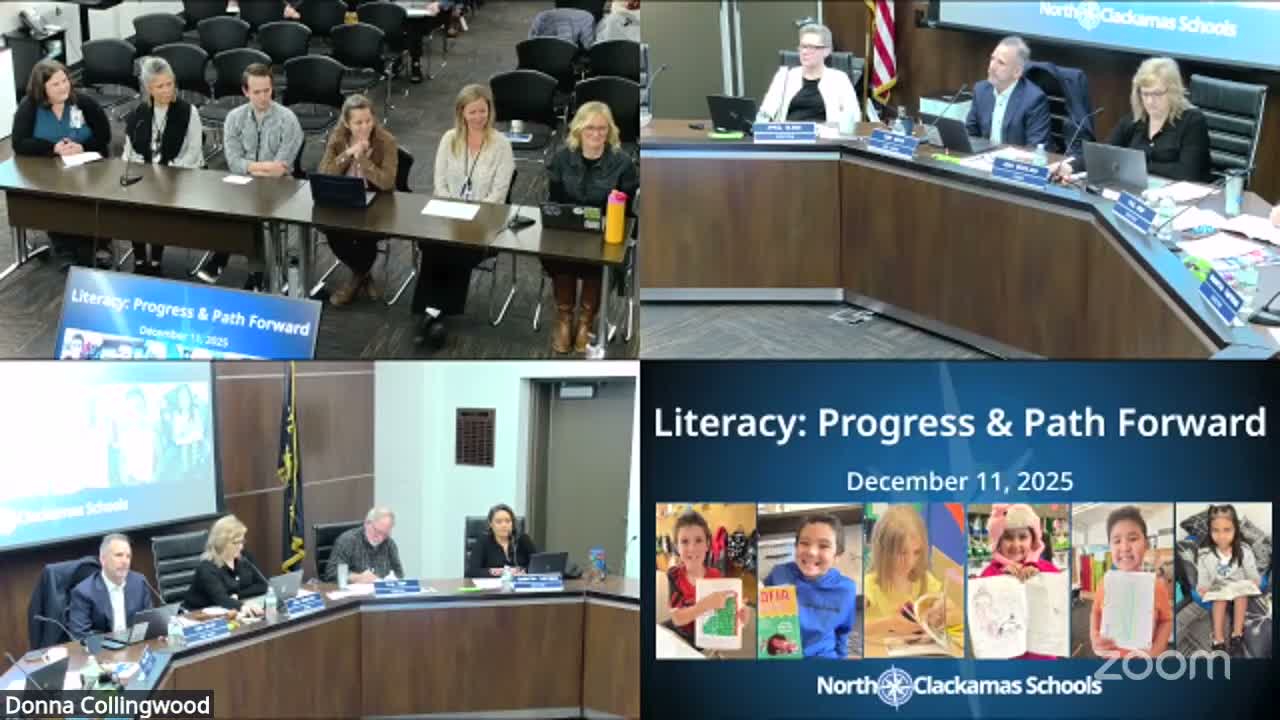
Summary
District leaders told the school board Dec. 11 that early-literacy initiatives tied to the science of reading and a coaching model drove gains: kindergarten proficiency rose from 35% to 65%, first grade from 37% to 59%, and combined third through fifth grade proficiency increased 5.5%, roughly 200 more students reaching grade-level standards.
North Clackamas School District leaders on Dec. 11 credited a coordinated, district-led literacy strategy for notable gains in early reading and for accelerating growth among historically underserved students.
"Our kindergarten proficiency has soared, rising from 35 percent pre-COVID to 65 percent in 2024-25," said Jen Burkhart, associate director of teaching, learning and professional development, summarizing data the district used to justify a multi-year initiative that pairs evidence-aligned materials with teacher coaching. She said first-grade proficiency climbed from 37% to 59%, and second grade reached 63%.
The report, presented to the board by Assistant Superintendent Yvonne Dibley and a team of coaches and principals, emphasized a three-tiered approach: strong whole-group core instruction, differentiated small-group lessons and targeted intervention time known as WIN ("what I need"). "This work does not happen overnight," Burkhart said, adding that the district organized teacher cohorts, professional learning communities and building-based coaching to spread practices.
District staff and principals said the approach produced measurable improvement. Principal Nathan Mount described Bilquist Elementary's work as a target school supported by an early-literacy grant and a k-3 literacy coach. "We finished the end of last year with 74% of our students on grade level," Mount said. Ardenwald Elementary Principal Rosina Hardy said focused coaching and data literacy among teachers moved second-grade proficiency from about 55% in the fall to 73% by year'end.
Presenters also reported that combined third-through-fifth grade proficiency rose 5.5% last spring, an increase they estimated represented about 200 additional students accessing grade-level standards; the district contrasted that gain with statewide growth reported at about 1%.
Board members pressed staff on how growth was calculated and how goals were set. Burkhart said the district tied school improvement plan goals to "ambitious growth," using benchmarks such as an expected 1.6 words-per-week growth rate to model how many students could reach grade level if they met that standard. "We calculated for your school how many kids would we move if they made that amount of growth or more," she said.
Staff described the coaching model as a district-directed system to ensure consistent professional learning and alignment across schools. "We made the coaching be under the direction of the district office," Dibley said, explaining that central coordination helped standardize messages and supports for principals and teachers.
The presentation also highlighted equity impacts: leaders said students of color historically showing the largest gaps accelerated at 16% during the year, narrowing a gap by nine percentage points. The district plans to extend the model into middle school with new literacy coaches and expand cohort-based professional learning into high school.
Board members generally praised the work and asked for family-engagement resources and clarity about coaching FTEs. Directors described the results as both "inspirational" and intentional, and the board requested follow-up on implementation details as the district scales the approach.
The district said it will continue monitoring benchmarks and operationalizing literacy checkpoints across grades so families can better track student progress.