
Board approves Project Lead The Way dual-credit agreement with RIT; students to pay $240 for three credits
Get AI-powered insights, summaries, and transcripts
Subscribe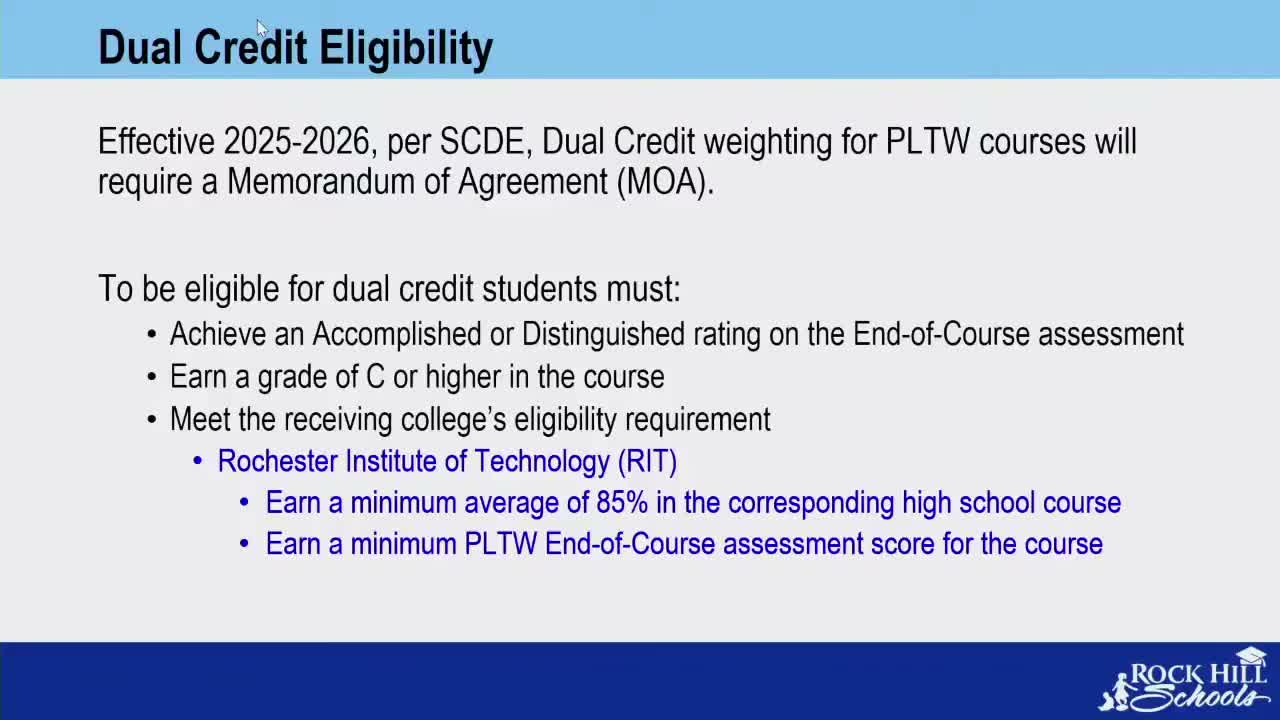
Summary
Trustees approved pursuing an MOA with Rochester Institute of Technology to let students buy dual-credit through Project Lead The Way for $240 per 3-credit course; board members discussed eligibility, assessment requirements and equity for students who cannot afford the fee.
The Rock Hill Schools board on Dec. 9 approved pursuing a memorandum of agreement with Rochester Institute of Technology that would allow high-school students enrolled in Project Lead The Way (PLTW) courses to purchase three college credits for $240 — markedly below typical tuition — provided students meet eligibility and assessment standards.
Alicia Johnson presented the proposal and said RIT, a longtime PLTW partner, requires a minimum course average (reported as 85 percent) and a course-assessment score for dual-credit eligibility. Johnson said the MOA requires the superintendent’s signature and that teachers would submit rosters for the college to verify which students meet eligibility. She added that statewide guidance now requires districts to have an MOA in place for PLTW students to receive dual credit.
Trustees pressed staff on why relatively few eligible students in a prior year elected to buy dual credit (77 eligible; three purchased credit last year), raised concerns about students who cannot afford the $240 fee, and asked whether scholarship or foundation support could help. Johnson said the district did not yet have specific scholarship sources identified.
After discussion, the board voted to approve the dual-credit pathway (motion carries 3–1). Trustees said they want district and foundation leaders to explore funding pathways so cost does not become a barrier for eligible students.